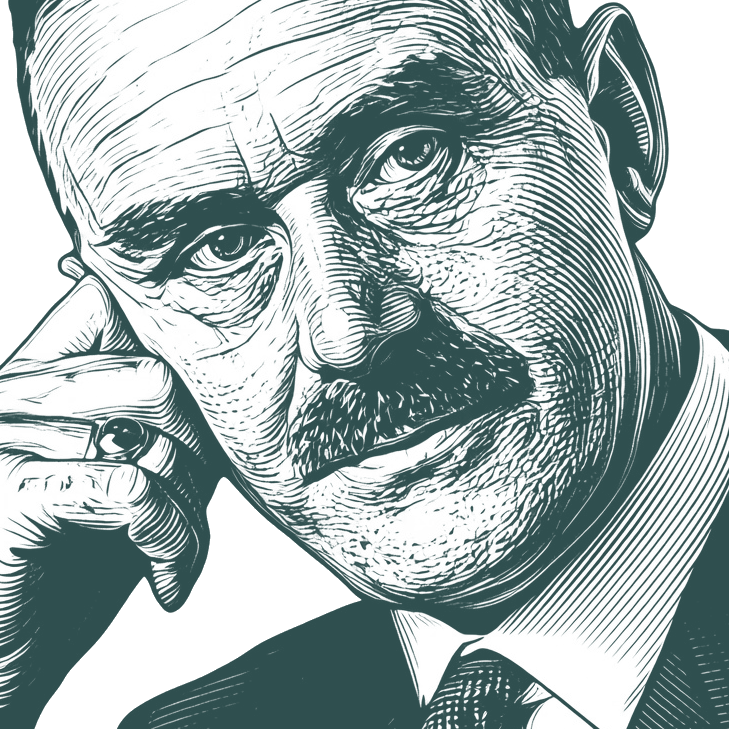
"Who then was the orthodox, who the freethinker? Where lay the true position, the true state of man? Should he descend into the all-consuming all-equ… - Thomas Mann
"Who then was the orthodox, who the freethinker? Where lay the true position, the true state of man? Should he descend into the all-consuming all-equalizing chaos, that ascetic-libertine state; or should he take his stand on the "Critical-Subjective," where empty bombast and a bourgeois strictness of morals contradicted each other? Ah, the principles and points of view constantly did that; it became so hard for Hans Castorp's civilian responsibility to distinguish between opposed positions, or even to keep the premises apart from each other and clear in his mind, that the temptation grew well-nigh irresistible to plunge head foremost into Naphtha's "morally chaotic All.
Paul Thomas Mann (6 June 1875 – 12 August 1955) was a German novelist, short story writer, social critic, philanthropist, essayist, and 1929 Nobel Prize laureate, known for his series of highly symbolic and ironic epic novels and mid-length stories, noted for their insight into the psychology of the artist and the intellectual.
Biography information from
Wikiquote·
Portrait adapted from
Wikimedia Commons, Nobel Foundation (Public domain / CC0)
Space, like time, engenders forgetfulness; but it does so by setting us bodily free from our surroundings and giving us back our primitive, unattached state. Yes, it can even, in the twinkling of an eye, make something like a vagabond of the pedant and Philistine. Time, we say, is Lethe; but change of air is a similar draught, and, if it works less thoroughly, does so more quickly.
...when life still hesitates to touch us, when neither duty nor guilt dares lay a hand upon us
Unlimited Quote Collections
Organize your favorite quotes without limits. Create themed collections for every occasion with Premium.
Time cools, time clarifies, no mood can be maintained quite unaltered through the course of hours. In the early dawn, standing weapon in hand, neither of the combatants would be the same man as on the evening of the quarrel. They would be going through it, if at all, mechanically, in obedience to the demands of honour, not, as they would have at first, of their own free will, desire, and conviction; and such a denial of their actual selves in favour of their past ones, it must somehow be possible to prevent.