"When you stopped believing in God," he went on, "did you stop believing in good and evil?"
"No. But I stopped believing there was a power of good a… - Philip Pullman
"When you stopped believing in God," he went on, "did you stop believing in good and evil?"
"No. But I stopped believing there was a power of good and a power of evil that were outside us. And I came to believe that good and evil are names for what people do, not for what they are. All we can say is that this is a good deed, because it helps someone, or that's an evil one, because it hurts them. People are too complicated to have simple labels."
Philip Pullman CBE (born October 19, 1946) is an English writer. He is the best-selling author of His Dark Materials, a trilogy of fantasy novels, and a number of other books.
Biography information from
Wikiquote·
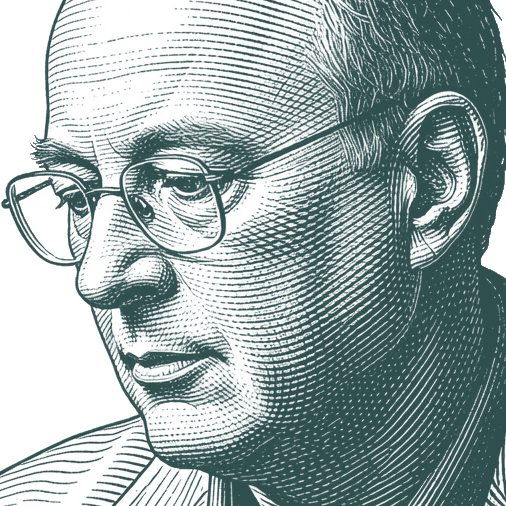
Portrait adapted from
Wikimedia Commons, Photographed by Adrian Hon, http://mssv.net/ (CC BY-SA)
Also Known As
Alternative Names:
Sir Philip Pullman
•
Sir Philip Nicholas Outram Pullman
You won't understand anything about imagination until you realise that it's not about making things up, it's about perception.
If a coin comes down heads, that means that the possibility of its coming down tails has collapsed. Until that moment the two possibilities were equal. But on another world, it does come down tails. And when that happens, the two worlds split apart.
Try QuoteGPT
Chat naturally about what you need. Each answer links back to real quotes with citations.
"Middlemarch is a novel that is diminished by being put on the screen. It can't help but be, because so much of what we enjoy in Middlemarch is the interplay between what the characters do and what we know about them because of the telling voice.
It's less of a problem for the cinema when it deals with novels that are purely concerned with action and what people do. I haven't thought this through, and I'm just trying it now to see what it sounds like. But maybe it would be less a problem with novels that are told in the first person. The interesting thing to me about Middlemarch, and Thackeray's Vanity Fair, and several other great novels, is precisely this omniscient, as we call it, third person, which naive readers mistake for the author. It isn't George Eliot who is saying this; it's a voice that George Eliot adopts to tell this story.
There can be something very interesting in a novel like Bleak House, which was also done very well on the television by the same adapter, Andrew Davis. Now, Bleak House is told in two voices, as you remember. One is the somewhat trying Esther Summerson, who is a paradigm of every kind of virtue, and the other is a different sort of voice entirely, a voice that tells the story in the present tense, which was unusual for the time, a voice that doesn't seem to have a main character attached to it.
But I think that Dickens is playing a very subtle game here. I've noticed a couple of things about that second narration that make me wonder whether it isn't Esther herself writing the other bits of it. For instance, at the very beginning, she says, "When I come to write my portion of these pages . . ." So she knows that there is another narrative going on, but nobody else does. Nobody else refers to it. The second thing is that she is the only character who never appears in those passages of present-tense narration. The other characters do. She doesn't. Why would that be? There's one point very near the end of the book where she almost d