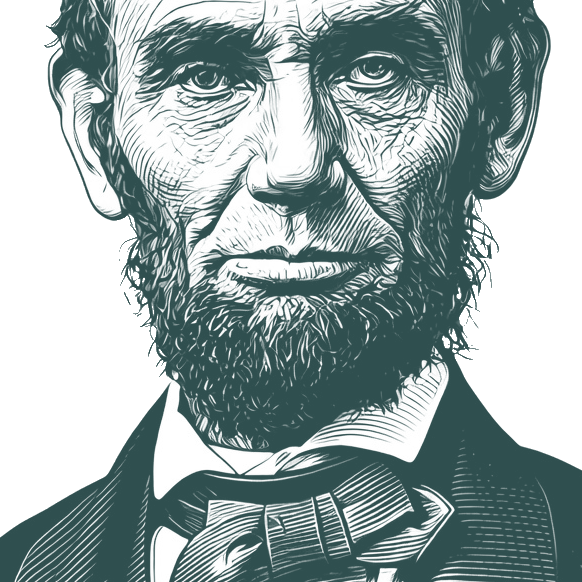
He desires to preserve the Government, that it may be administered for all as it was administered by the men who made it. Loyal citizens everywhere h… - Abraham Lincoln
""
He desires to preserve the Government, that it may be administered for all as it was administered by the men who made it. Loyal citizens everywhere have the right to claim this of their government, and the government has no right to withhold or neglect it. It is not perceived that in giving it there is any coercion, any conquest, or any subjugation in any just sense of those terms.
English
Collect this quote
About
Abraham Lincoln
Abraham Lincoln (12 February 1809 – 15 April 1865) was the 16th president of the United States, serving from March 1861 until his assassination in April 1865. Initially entering politics as a Whig, he became a member of the US congress from Illinois, and later the first Republican president, leading Union forces throughout the moral, constitutional, political and military crises of the American Civil War, during which he abolished slavery and strengthened the U.S. government.
Biography information from
Wikiquote·
Portrait adapted from
Wikimedia Commons, Alexander Gardner (Public domain / CC0)
Also Known As
Alternative Names:
Honest Abe
•
President Lincoln
•
Abe Lincoln
•
Uncle Abe
•
A. Lincoln
•
Lincoln
Get the books, and read and study them till, you understand them in their principal features; and that is the main thing. It is of no consequence to be in a large town while you are reading. I read at New-Salem, which never had three hundred people living in it. The books, and your capacity for understanding them, are just the same in all places. ... Always bear in mind that your own resolution to succeed, is more important than any other one thing.
I remember my mother's prayers and they have always followed me. They have clung to me all my life.
Go Premium
Support Quotewise while enjoying an ad-free experience and premium features.
In 1846 he was elected to the lower House of Congress, and served one term only, commencing in December, 1847, and ending with the inauguration of General Taylor, in March, 1849. All the battles of the Mexican war had been fought before Mr. Lincoln took his seat in Congress but the American army was still in Mexico, and the treaty of peace was not fully and formally ratified till the June afterwards. ...he voted for all the supply measures that came up, and for all the measures in any way favorable to the officers, soldiers, and their families, who conducted the war through: with the exception that some of these measures passed without yeas and nays, leaving no record as to how particular men voted. The "Journal" and "Globe" also show him voting that the war was unnecessarily and unconstitutionally begun by the President of the United States.