Halfway through the second term of Franklin Roosevelt, the New Deal braintrusters began to worry about mounting popular concern over the national deb… - William F. Buckley Jr.
""
Halfway through the second term of Franklin Roosevelt, the New Deal braintrusters began to worry about mounting popular concern over the national debt. In those days the size of the national debt was on everyone’s mind. Indeed, Franklin Roosevelt had talked himself into office, in 1932, in part by promising to hack away at a debt which, even under the frugal Mr. Hoover, the people tended to think of as grown to menacing size. Mr. Roosevelt’s wisemen worried deeply about the mounting tension ...
And then, suddenly, the academic community came to the rescue. Economists across the length and breadth of the land were electrified by a theory of debt introduced in England by John Maynard Keynes. The politicians wrung their hands in gratitude. Depicting the intoxicating political consequences of Lord Keynes’s discovery, the wry cartoonist of the Washington Times Herald drew a memorable picture. In the center, sitting on a throne in front of a Maypole, was a jubilant FDR, cigarette tilted almost vertically, a grin on his face that stretched from ear to ear. Dancing about him in a circle, hands clasped together, their faces glowing with ecstasy, the braintrusters, vested in academic robes, sang the magical incantation, the great discovery of Lord Keynes: “We owe it to ourselves.” With five talismanic words, the planners had disposed of the problem of deficit spending. Anyone thenceforward who worried about an increase in the national debt was just plain ignorant of the central insight of modern economics: What do we care how much we - the government - owe so long as we owe it to ourselves? On with the spending. Tax and tax, spend and spend, elect and elect ...
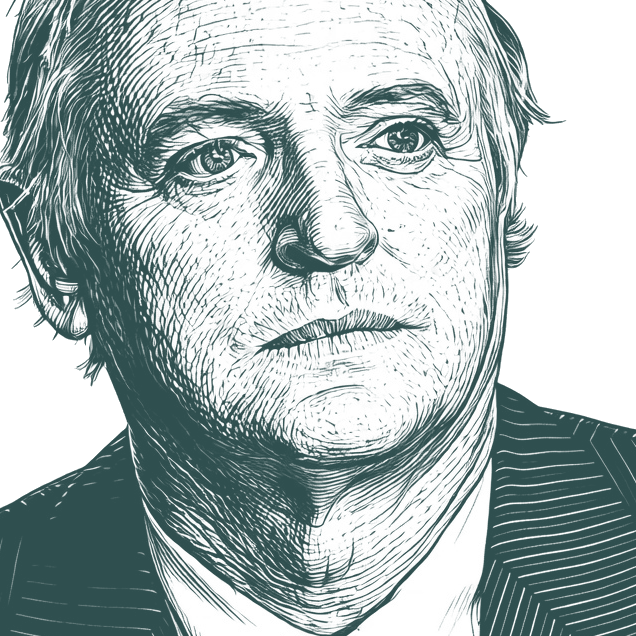
William F. Buckley, Jr. (November 24 1925 - February 27 2008) was an American author, conservative journalist, who founded the conservative political magazine National Review in 1955 and hosted the television show Firing Line from 1966 until 1999.
Biography information from
Wikiquote·
Portrait adapted from
Wikimedia Commons, SPC 5 Bert Goulait, US Military (Public domain / CC0)
Also Known As
Native Name:
William Frank Buckley, Jr.
Alternative Names:
William Frank Buckley Jr.
•
William Frank Buckley
•
William F. Buckley, Jr.
when both can’t be true. In 1946, in the days after World War II, presidential advisor Bernard Baruch said, “Every man has a right to his own opinion, but no man has a right to be wrong in his facts.” Variations have been uttered by U.S. Secretary of Defense James R. Schlesinger, U.S. Senator Daniel Patrick Moynihan, and others. Today this seemingly indisputable truth no longer holds. Propaganda is indistinguishable from fact and we find ourselves living in the frightening pages of a George Orwell novel.
Those who suffer from the abuse of drugs have themselves to blame for it. This does not mean that society is absolved from active concern for their plight. It does mean that their plight is subordinate to the plight of those citizens who do not experiment with drugs but whose life, liberty, and property are substantially affected by the illegalization of the drugs sought after by the minority.
Limited Time Offer
Premium members can get their quote collection automatically imported into their Quotewise collections.
Do you favor mandated free tuition?” I answered: “Most positively not.” The crowd unanimously and lustily booed me. “Do you realize,” I persisted, “that you are asking men and women who are, many of them poorer than you, and poorer than your parents; many of whom earn less money than you yourselves will be earning in the course of a few years, to make sacrifices in your behalf?” Boo! “If you don’t believe me,” I said, “go to your economics teachers and ask them.” Boo! “All right,” I said, “don’t go to your economics teachers, and don’t discover the economic realities — you’ll find it much easier on the conscience not to know who is sustaining the hardship for your free education.” Applause! — as a matter of fact.