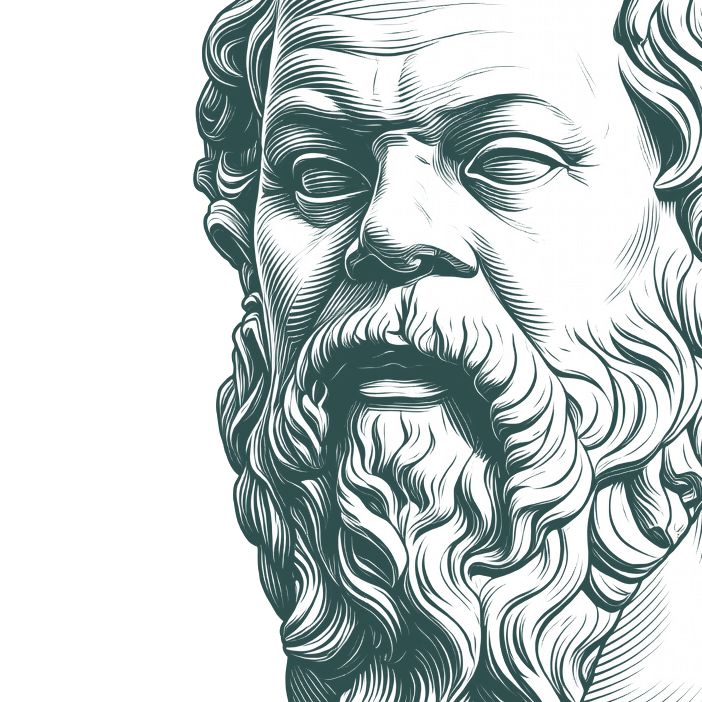
Socrates (Σωκράτης; c. 470 BC – 399 BC) was a classical Greek (Athenian) philosopher credited as one of the founders of Western philosophy. Through his portrayal in Plato's dialogues, Socrates has become renowned for his contribution to the field of ethics, and it is this Platonic Socrates who lends his name to the concepts of Socratic irony and the Socratic method, or elenchus. The latter remains a commonly used tool in a wide range of discussions, and is a type of pedagogy in which a series of questions is asked not only to draw individual answers, but also to encourage fundamental insight into the issue at hand.
Biography information from
Wikiquote·
Portrait adapted from
Wikimedia Commons, Copy of Lysippos (?) (Public domain / CC0)
Upon the earth are animals and men, some in a middle region, others dwelling about the air as we dwell about the sea; others in islands which the air flows round, near the continent; and in a word, the air is used by them as the water and the sea are by us, and the ether is to them as the air is to us. Moreover, the temperament of their seasons is such that they have no disease, and live much longer than we do, and have sight and hearing and smell, and all the other senses, in far greater perfection, in the same degree that air is purer than water or the ether than air. Also they have temples and sacred places in which the gods really dwell, and they hear their voices and receive their answers and are conscious of them and hold converse with them, and they see the sun, moon, and stars as they really are, and their other blessedness is of a piece with this.
Perhaps someone may say 'But surely, Socrates, after you have left us you can spend the rest of your life in quietly minding your own business.' This is the hardest thing of all to make some of you understand. If I say that this would be disobedience to God, and that is why I cannot 'mind my own business', you will not believe that I am serious. If on the other hand I tell you that to let no day pass without discussing goodness and all the other subjects about which you hear me talking and examining both myself and others is really the best thing that a man can do, and that life without this sort of examination is not worth living, you will be even less inclined to believe me. Nevertheless, that is how it is, gentlemen, as I maintain; though it is not easy to convince you of it.
PREMIUM FEATURE
Advanced Search Filters
Filter search results by source, date, and more with our premium search tools.
As for me, all I know is that I know nothing, for when I don't know what justice is, I'll hardly know whether it is a kind of virtue or not, or whether a person who has it is happy or unhappy.