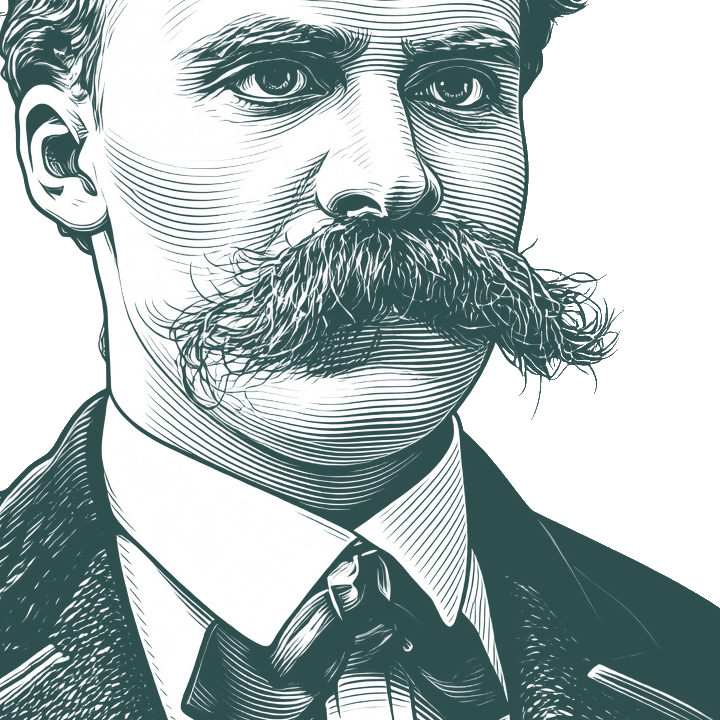
No one can draw more out of things, books included, than he already knows. A man has no ears for that to which experience has given him no access. - Friedrich Nietzsche
""
No one can draw more out of things, books included, than he already knows. A man has no ears for that to which experience has given him no access.
English
Collect this quote
About
Friedrich Nietzsche
Friedrich Wilhelm Nietzsche (15 October 1844 – 25 August 1900) was a German philosopher, cultural critic, composer, poet, writer, and philologist whose work has exerted a profound influence on modern intellectual history. His critiques of contemporary culture, religion, and philosophy centered on a basic question regarding the foundation of values and morality.
Biography information from
Wikiquote·
Portrait adapted from
Wikimedia Commons, Friedrich Hermann Hartmann (Public domain / CC0)
Also Known As
Alternative Names:
Friedrich Wilhelm Nietzsche
•
Nietzsche
Philosophy leaps ahead on tiny toeholds; hope and intuition lend wings to its feet. Calculating reason lumbers heavily behind, looking for better footholds, for reason too wants to reach that alluring goal which its divine comrade has long since reached.
One has to test oneself to see that one is destined for independence and command — and do it at the right time. One should not dodge one’s tests, though they may be the most dangerous game one could play and are tests that are taken in the end before no witness or judge but ourselves. Not to remain stuck to a person — not even the most loved — every person is a prison, also a nook.
Not to remain stuck to a fatherland — not even if it suffers most and needs help most — it is less difficult to sever one’s heart from a victorious fatherland. Not to remain stuck to some pity — not even for higher men into whose rare torture and helplessness some accident allowed us to look.
Not to remain stuck to a science — even if it should lure us with the most precious finds that seem to have been saved up precisely for us. Not to remain stuck to one’s own detachment, to that voluptuous remoteness and strangeness of the bird who flees ever higher to see ever more below him — the danger of the flier.
Not to remain stuck to our own virtues and become as a whole the victim of some detail in us, such as our hospitality, which is the danger of dangers for superior and rich souls who spend themselves lavishly, almost indifferently, and exaggerate the virtue of generosity into a vice.
One must know how to conserve oneself: the hardest test of independence.
Works in ChatGPT, Claude, or Any AI
Add semantic quote search to your AI assistant via MCP. One command setup.
That which Heraclitus avoided, however, is still the same at that which we shun today: the noise and democratic chatter of the Ephesians, their politics, their latest news of the “Empire,” ... their market business of “today”—for we philosophers need to be spared one thing above all: everything to do with “today.” We reverence what is still, cold, noble, distant, past, and in general everything in the face of which the soul does not have to defend itself and wrap itself up.