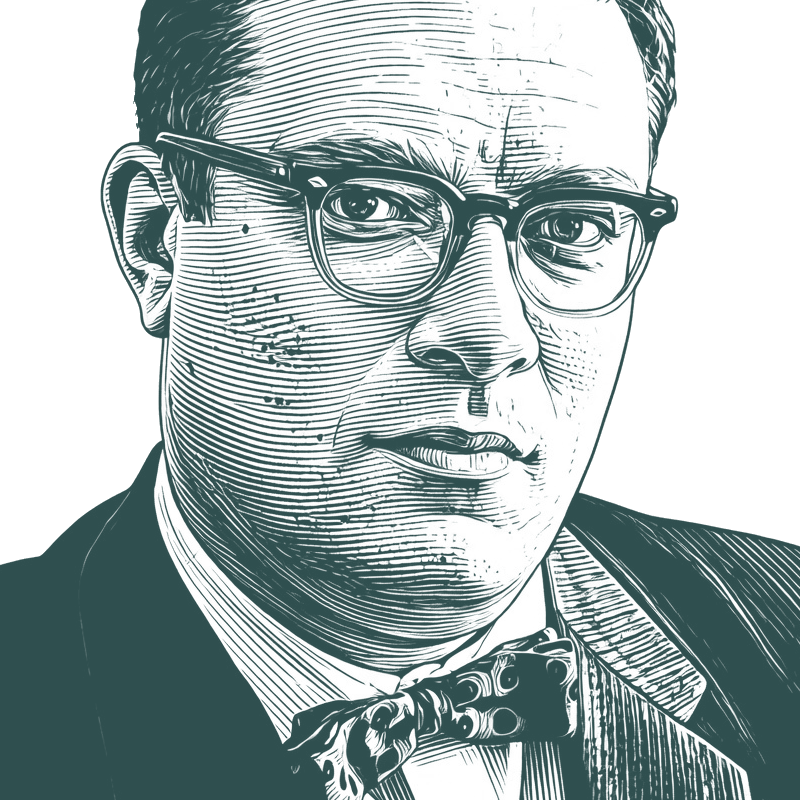
Isaac Asimov (c. 2 January 1920 – 6 April 1992) was a Russian-born American biochemist who was a prolific writer of both fiction and non-fiction, his works include the Foundation series and I, Robot.
Biography information from
Wikiquote·
Portrait adapted from
Wikimedia Commons, Phillip Leonian [1] from New York World-Telegram & Sun.[2] (Public domain / CC0)
Also Known As
Alternative Names:
Isaak Osimov
•
Paul French
•
Asimov
•
Isaak Ozimov
•
Itzhak Ozimov
Portrait from Wikimedia Commons. Credit: Phillip Leonian [1] from New York World-Telegram & Sun.[2]. Used under Public domain / CC0. Processed and styled by Quotewise.
Try QuoteGPT
Chat naturally about what you need. Each answer links back to real quotes with citations.
Related quotes. More quotes will automatically load as you scroll down, or you can use the load more buttons.
The next major figure in the Bible is Abraham, the spiritual ancestor of Jews, Christians, and Muslims. Abraham has a nephew, Lot, who settles in Sodom. Because the residents engage in anal sex and comparable sins, God immolates every man, woman, and child in a divine napalm attack. Lot’s wife, for the crime of turning around to look at the inferno, is put to death as well. Abraham undergoes a test of his moral values when God orders him to take his son Isaac to a mountaintop, tie him up, cut his throat, and burn his body as a gift to the Lord. Isaac is spared only because at the last moment an angel stays his father’s hand. For millennia readers have puzzled over why God insisted on this horrifying trial. One interpretation is that God intervened not because Abraham had passed the test but because he had failed it, but that is anachronistic: obedience to divine authority, not reverence for human life, was the cardinal virtue. Isaac’s son Jacob has a daughter, Dinah. Dinah is kidnapped and raped—apparently a customary form of courtship at the time, since the rapist’s family then offers to purchase her from her own family as a wife for the rapist. Dinah’s brothers explain that an important moral principle stands in the way of this transaction: the rapist is uncircumcised. So they make a counteroffer: if all the men in the rapist’s hometown cut off their foreskins, Dinah will be theirs. While the men are incapacitated with bleeding penises, the brothers invade the city, plunder and destroy it, massacre the men, and carry off the women and children. When Jacob worries that neighboring tribes may attack them in revenge, his sons explain that it was worth the risk: “Should our sister be treated like a whore?” Soon afterward they reiterate their commitment to family values by selling their brother Joseph into slavery.
We are meant to know, or we are amoebae. Suppose that we are wise enough to learn and know — and yet not wise enough to control our learning and knowledge, so that we use it to destroy ourselves? Even if that is so, knowledge remains better than ignorance. It is better to know — even if the knowledge endured only for the moment that comes before destruction — than to gain eternal life at the price of a dull and swinish lack of comprehension of a universe that swirls unseen before us in all its wonder. That was the choice of Achilles, and it is mine, too.
Go Premium
Support Quotewise while enjoying an ad-free experience and premium features.