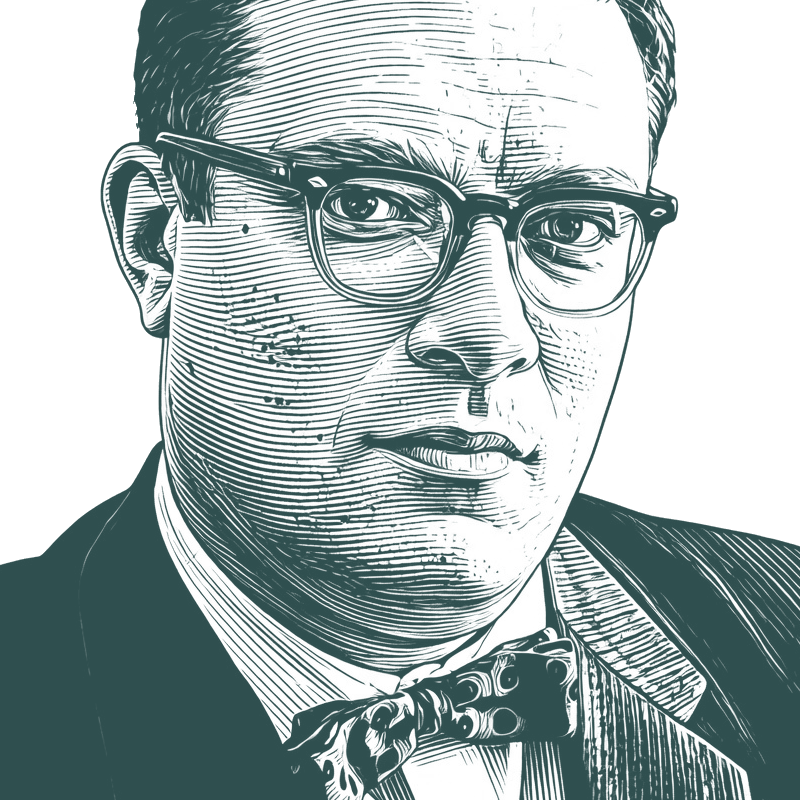
A perda de massa pode ser minimizada se sua velocidade aumentar imensamente, uma vez que o impulso é igual à massa multiplicada pela velocidade. Apes… - Isaac Asimov
""
A perda de massa pode ser minimizada se sua velocidade aumentar imensamente, uma vez que o impulso é igual à massa multiplicada pela velocidade. Apesar disso, por maior que seja a velocidade, uma parte da massa deve ser descartada. Se a massa que deve ser acelerada é enorme, em primeiro lugar, então a massa a ser descartada também é enorme.
Isaac Asimov (c. 2 January 1920 – 6 April 1992) was a Russian-born American biochemist who was a prolific writer of both fiction and non-fiction, his works include the Foundation series and I, Robot.
Biography information from
Wikiquote·
Portrait adapted from
Wikimedia Commons, Phillip Leonian [1] from New York World-Telegram & Sun.[2] (Public domain / CC0)
Also Known As
Alternative Names:
Isaak Osimov
•
Paul French
•
Asimov
•
Isaak Ozimov
•
Itzhak Ozimov
Portrait from Wikimedia Commons. Credit: Phillip Leonian [1] from New York World-Telegram & Sun.[2]. Used under Public domain / CC0. Processed and styled by Quotewise.
Enhance Your Quote Experience
Enjoy ad-free browsing, unlimited collections, and advanced search features with Premium.
If a modified robot were to drop a heavy weight upon a human being, he would not be breaking the First Law, if he did so with the knowledge that his strength and reaction speed would be sufficient to snatch the weight away before it struck the man. However once the weight left his fingers, he would be no longer the active medium. Only the blind force of gravity would be that. The robot could then change his mind and merely by inaction, allow the weight to strike. The modified First Law allows that" (79).
Think, that for all time, all conflicts are finally evitable. Only the Machines, from now on, are inevitable!
With remarkable reluctance he touched the pink spot again and this time steeled his body for the icy spray. Mild water? He found suds forming on his body and he rubbed hastily here, there, everywhere, judging it to be the wash cycle and suspecting it would not last long. Then came the rinse cycle. Ah, warm — Well, perhaps not warm, but not quite as cold, and definitely feeling warm to his thoroughly chilled body. Then, even as he was considering touching the contact spot again to stop the water, and was wondering how Lizalor had come out dry when there was absolutely no towel or towel-substitute in the place — the water stopped. It was followed by a blast of air that would have certainly bowled him over if it had not come from various directions equally. It was hot; almost too hot. It took far less energy, Trevize knew, to heat air than to heat water. The hot air steamed the water off him and, in a few minutes, he was able to step out as dry as though he had never encountered water in his life.