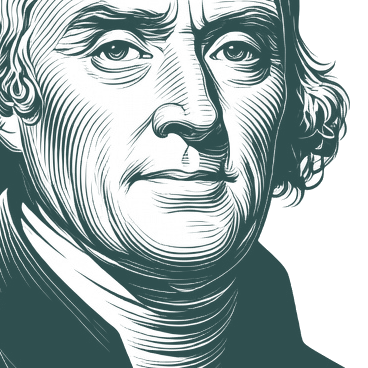
[...] Congress itself can punish Alexandria, by repealing the law which made it a town, by discontinuing it as a port of entry or clearance, and perh… - Thomas Jefferson
""
[...] Congress itself can punish Alexandria, by repealing the law which made it a town, by discontinuing it as a port of entry or clearance, and perhaps by suppressing it’s banks. But I expect all will go off with impunity. If our government ever fails, it will be from this weakness. No government can be maintained without the principle of fear as well as of duty. Good men will obey the last, but bad ones the former only.
Thomas Jefferson (13 April 1743 – 4 July 1826) was author of the Declaration of Independence (1776) and the Virginia Statute for Religious Freedom (1777), founder of the University of Virginia (1819), the third president of the United States (1801–1809), a political philosopher, editor of Jefferson's Bible (1819), and one of the most influential founders of the United States.
Biography information from
Wikiquote·
Portrait adapted from
Wikimedia Commons, Rembrandt Peale (Public domain / CC0)
Also Known As
Alternative Names:
President Jefferson
•
T. Jefferson
To compel a man to subsidize with his taxes the propagation of ideas which he disbelieves and abhors is sinful and tyrannical.
And can the liberties of a nation be thought secure when we have removed their only firm basis, a conviction in the minds of the people that these liberties are the gift of God? That they are not to be violated but with His wrath? Indeed, I tremble for my country when I reflect that God is just; that his justice cannot sleep forever.
If we could believe that he [Jesus] really countenanced the follies, the falsehoods, and the charlatanism which his biographers [Gospels] father on him, and admit the misconstructions, interpolations, and theorizations of the fathers of the early, and the fanatics of the latter ages, the conclusion would be irresistible by every sound mind that he was an impostor... We find in the writings of his biographers matter of two distinct descriptions. First, a groundwork of vulgar ignorance, of things impossible, of superstitions, fanaticisms and fabrications... That sect [Jews] had presented for the object of their worship, a being of terrific character, cruel, vindictive, capricious and unjust... Jesus had to walk on the perilous confines of reason and religion: and a step to right or left might place him within the gripe of the priests of the superstition, a blood thirsty race, as cruel and remorseless as the being whom they represented as the family God of Abraham, of Isaac and of Jacob, and the local God of Israel. They were constantly laying snares, too, to entangle him in the web of the law... That Jesus did not mean to impose himself on mankind as the son of God, physically speaking, I have been convinced by the writings of men more learned than myself in that lore.