In actuality, it was like the homes of all people who are not really rich but who want to look rich, and therefore end up looking like one another: i… - Leo Tolstoy
""
In actuality, it was like the homes of all people who are not really rich but who want to look rich, and therefore end up looking like one another: it had damasks, ebony, plants, carpets, and bronzes, everything dark and gleaming — all the effects a certain class of people produce so as to look like people of a certain class. And his place looked so much like the others that it would never have been noticed, though it all seemed quite exceptional to him.
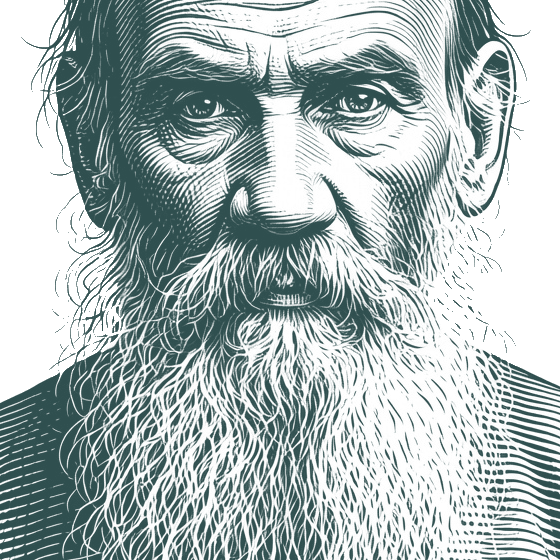
Lev Nikolayevitch Tolstoy [Ле́в Никола́евич Толсто́й, usually rendered Leo Tolstoy, or sometimes Tolstoi] (9 September 1828 – 20 November 1910) was a Russian writer, philosopher and social activist (social critic), whose novels War and Peace and Anna Karenina are internationally praised classics of world literature. He was a major influence on the development of Christian anarchism and pacifism, contributing to such nonviolent resistance movements as those of Mahatma Gandhi, Martin Luther King, Jr., and James Bevel.
Biography information from
Wikiquote·
Portrait adapted from
Wikimedia Commons, Sergei Prokudin-Gorskii (Public domain / CC0)
Also Known As
Pen Names:
Л. Н. Т.
•
Л. Н.
Birth Name:
Lev Nikolayevich Tolstoy
Native Name:
Лев Никола́евич Толсто́й
Alternative Names:
Count Lev Nikolayevich Tolstoy
•
Tolstoy, Leo, graf, 1828-1910
•
Tolstoĭ, Lev Nikolaevich, graf, 1828-1910
•
Lev Nikolayevich Tolstoĭ
•
Leo Tolstoi
•
Tolstoĭ, Lev Nikolaevich, graf
•
Tolstoy, Leo, graf
"I have nothing to make me miserable," she said, getting calmer; "but can you understand that everything has become hateful, loathsome, coarse to me, and I myself most of all? You can't imagine what loathsome thoughts I have about everything."
"Why, whatever loathsome thoughts can you have?" asked Dolly, smiling.
"The most utterly loathsome and coarse; I can't tell you. It's not unhappiness, or low spirits, but much worse. As though everything that was good in me was all hidden away, and nothing was left but the most loathsome."
But that had been grief — this was joy. Yet that grief and this joy were alike outside all the ordinary conditions of life; they were loopholes, as it were, in that ordinary life through which there came glimpses of something sublime. And in the contemplation of this sublime something the soul was exalted to inconceivable heights of which it had before had no conception, while reason lagged behind, unable to keep up with it.
Go Premium
Support Quotewise while enjoying an ad-free experience and premium features.
These new justifications are termed "scientific". But by the term "scientific" is understood just what was formerly understood by the term "religious": just as formerly everything called "religious" was held to be unquestionable simply because it was called religious, so now all that is called "scientific" is held to be unquestionable. In the present case the obsolete religious justification of violence which consisted in the recognition of the supernatural personality of the God-ordained ruler ("there is no power but of God") has been superseded by the "scientific" justification which puts forward, first, the assertion that because the coercion of man by man has existed in all ages, it follows that such coercion must continue to exist. This assertion that people should continue to live as they have done throughout past ages rather than as their reason and conscience indicate, is what "science" calls "the historic law". A further "scientific" justification lies in the statement that as among plants and wild beasts there is a constant struggle for existence which always results in the survival of the fittest, a similar struggle should be carried on among humanbeings, that is, who are gifted with intelligence and love; faculties lacking in the creatures subject to the struggle for existence and survival of the fittest. Such is the second "scientific" justification. The third, most important, and unfortunately most widespread justification is, at bottom, the age-old religious one just a little altered: that in public life the suppression of some for the protection of the majority cannot be avoided — so that coercion is unavoidable however desirable reliance on love alone might be in human intercourse. The only difference in this justification by pseudo-science consists in the fact that, to the question why such and such people and not others have the right to decide against whom violence may and must be used, pseudo-science now gives a different reply to that given by religion — which declared that the right to decide was valid because it was pronounced by persons possessed of divine power. "Science" says that these decisions represent the will of the people, which under a constitutional form of government is supposed to find expression in all the decisions and actions of those who are at the helm at the moment. Such are the scientific justifications of the principle of coercion. They are not merely weak but absolutely invalid, yet they are so much needed by those who occupy privileged positions that they believe in them as blindly as they formerly believed in the immaculate conception, and propagate them just as confidently. And the unfortunate majority of men bound to toil is so dazzled by the pomp with which these "scientific truths" are presented, that under this new influence it accepts these scientific stupidities for holy truth, just as it formerly accepted the pseudo-religious justifications; and it continues to submit to the present holders of power who are just as hard-hearted but rather more numerous than before.