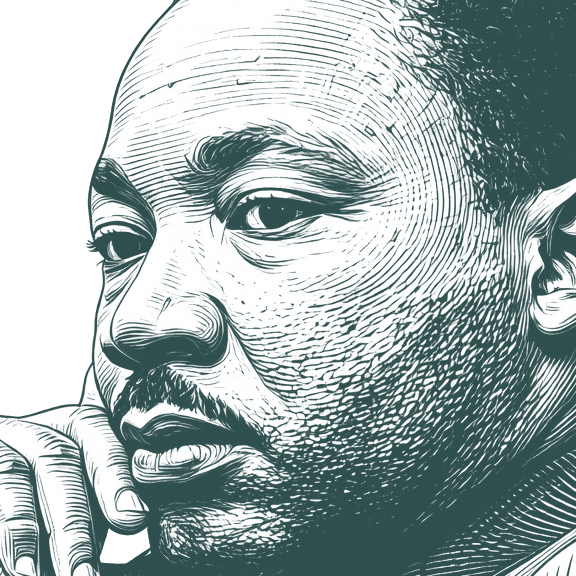
This faith transforms the whirlwind of despair into a warm and reviving breeze of hope. The words of a motto which a generation ago were commonly fou… - Martin Luther King Jr.
""
This faith transforms the whirlwind of despair into a warm and reviving breeze of hope. The words of a motto which a generation ago were commonly found on the wall in the homes of devout persons need to be etched on our hearts: Fear knocked at the door. Faith answered. There was no one there.
Dr. Martin Luther King Jr. (15 January 1929 – 4 April 1968) was an American Baptist minister, civil rights activist, and recipient of the Nobel Peace Prize of 1964. He was the husband of Coretta Scott King, and father of Yolanda King and Martin Luther King III.
Biography information from
Wikiquote·
Portrait adapted from
Wikimedia Commons, Yoichi Okamoto (Public domain / CC0)
Also Known As
Birth Name:
Michael King Jr.
Alternative Names:
Martin Luther King, Jr.
•
Dr. Martin Luther King, Jr.
•
Martin Luther King
•
Michael King
•
Dr. King
•
M. L. King
•
M.L. King
•
ML King
•
MLK
•
Martin Luther King Junior
•
Michael King Junior
•
Rev. Dr. Martin Luther King Jr.
•
The Rev. Dr. Martin Luther King Jr.
Justice is a temporary thing that must at last come to an end; but the conscience is eternal and will never die.
I think one of the best ways to face this problem of self-centeredness is to discover some cause and some purpose, some loyalty outside of yourself and give yourself to that something. The best way to handle it is not to suppress the ego but to extend the ego into objectively meaningful channels. And so many people are unhappy because they aren't doing anything. They're self-centered because they aren't doing anything. They haven't given themselves to anything and they just move around in their little circles. One of the ways to rise above this self-centeredness is to move away from self and objectify yourself in something outside of yourself. Find some great cause and some great purpose, some loyalty to which you can give yourself and become so absorbed in that something that you give your life to it. Men and women have done this throughout all of the generations. And they have found that necessary ego satisfaction that life presents and that one desires through projecting self in something outside of self. As I said, you don't solve the problem by trying to trample over the ego altogether. That doesn't solve the problem. For you will always have the ego and the ego has certain desires, certain desires for significance. The three great psychoanalysts of this age, of this century, pointed out that there are certain basic desires that human beings have and that they long for and that they seek at any cost. And so for Freud the basic desire was to be loved. Jung would say that the basic desire is to be secure. But then Adler comes along and says the basic desire of human nature is to feel important and a sense of significance. And I think of all of those, probably- certainly all are significant but the one that Adler mentions is probably even more significant than any: that all human beings have a desire to belong and to feel significant and important. And the way to solve this problem is not to drown out the ego but to find your sense of importance in something outside of the self. And you are then able to live because you have given your life to something outside and something that is meaningful, objectified. You rise above this self-absorption to something outside. This is the way to go through life with a balance, with the proper perspective because you've given yourself to something greater than self. Sometimes it's friends, sometimes it's family, sometimes it's a great cause, it's a great loyalty, but give yourself to that something and life becomes meaningful.
Try QuoteGPT
Chat naturally about what you need. Each answer links back to real quotes with citations.
The fact that most of the time human beings put the truth about the nature and risks of the nuclear war out of their minds because it is too painful and therefore not "acceptable", does not alter the nature and risks of such war. The device of "rejection" may temporarily cover up anxiety, but it does not bestow peace of mind and emotional security.