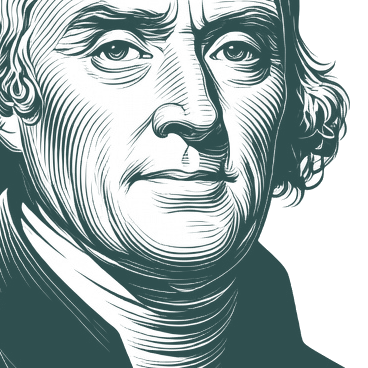
May it [American independence] be to the world, what I believe it will be, (to some parts sooner, to others later, but finally to all,) the signal of… - Thomas Jefferson
""
May it [American independence] be to the world, what I believe it will be, (to some parts sooner, to others later, but finally to all,) the signal of arousing men to burst the chains under which monkish ignorance and superstition had persuaded them to bind themselves, and to assume the blessings and security of self-government. That form which we have substituted, restores the free right to the unbounded exercise of reason and freedom of opinion. All eyes are opened, or opening, to the rights of man. The general spread of the light of science has already laid open to every view the palpable truth, that the mass of mankind has not been born with saddles on their backs, nor a favored few booted and spurred, ready to ride them legitimately... These are grounds of hope for others. For ourselves, let the annual return of this day forever refresh our recollections of these rights, and an undiminished devotion to them.
[Letter to Roger C. Weightman on the anniversary of the signing of the Declaration of Independence in 1776, 24 June 1826. This was Jefferson's last letter]
Thomas Jefferson (13 April 1743 – 4 July 1826) was author of the Declaration of Independence (1776) and the Virginia Statute for Religious Freedom (1777), founder of the University of Virginia (1819), the third president of the United States (1801–1809), a political philosopher, editor of Jefferson's Bible (1819), and one of the most influential founders of the United States.
Biography information from
Wikiquote·
Portrait adapted from
Wikimedia Commons, Rembrandt Peale (Public domain / CC0)
Also Known As
Alternative Names:
President Jefferson
•
T. Jefferson
Related quotes. More quotes will automatically load as you scroll down, or you can use the load more buttons.
Shorter versions of this quote
May it be to the world, what I believe it will be, (to some parts sooner, to others later, but finally to all), the signal of arousing men to burst the chains under which monkish ignorance and superstition had persuaded them to bind themselves, and to assume the blessings and security of self-government.
Happy in the prospect of a restoration of primitive Christianity, I must leave to younger athletes to encounter and lop off the false branches which have been engrafted into it by the mythologists of the middle and modern ages.
Experience hath shewn, that even under the best forms, those entrusted with power have, in time, and by slow operations, perverted it into tyranny; and it is believed that the most effectual means of preventing this would be, to illuminate, as far as practicable, the minds of the people at large...
Whatever enables us to go to war, secures our peace