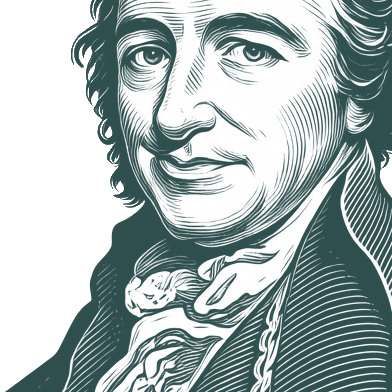
In England a king hath little more to do than to make war and give away places; which in plain terms, is to impoverish the nation and set it together… - Thomas Paine
""
In England a king hath little more to do than to make war and give away places; which in plain terms, is to impoverish the nation and set it together by the ears. A pretty business indeed for a man to be allowed eight hundred thousand sterling a year for, and worshipped into the bargain! Of more worth is one honest man to society and in the sight of God, than all the crowned ruffians that ever lived.
English
Collect this quote
About
Thomas Paine
Thomas Paine (February 9, 1737 [O.S. January 29, 1736] – 8 June 1809) was a British-American political writer, theorist, and activist who had a great influence on the thoughts and ideas which led to the American Revolution and the United States Declaration of Independence. He wrote three of the most influential and controversial works of the 18th Century: Common Sense, Rights of Man, and The Age of Reason. His ideas reflected Enlightenment-era ideals of transnational human rights.
Biography information from
Wikiquote·
Portrait adapted from
Wikimedia Commons, Auguste Millière / After George Romney / After William Sharp (Public domain / CC0)
Portrait from Wikimedia Commons. Credit: Auguste Millière / After George Romney / After William Sharp. Used under Public domain / CC0. Processed and styled by Quotewise.
Go Premium
Support Quotewise while enjoying an ad-free experience and premium features.
We have a perfect idea of a natural enemy when we think of the devil, because the enmity is perpetual, unalterable and unabateable. It admits, neither of peace, truce, or treaty; consequently the warfare eternal and therefore is natural. But man with man cannot arrange in the same opposition. Their quarrels are accidental and equivocally created. They become friends or enemies as the change of temper, or the cast of interest inclines them. The Creator of man did not constitute them the natural enemy of each other. He has not made any one order of beings so. Even wolves may quarrel, still they herd together. If any two nations are so, then must all nations be so, otherwise it is not nature but custom, and the offence frequently originates with the accuser.
neither does he say anything of the story related in the second chapter of the same book of Kings, of a parcel of children calling Elisha bald head, bald head; and that this man of God, verse 24, “Turned back, and looked on them, and cursed them in the name of the Lord; and there came forth two she-bears out of the wood, and tore forty-and-two children of them.
Works in ChatGPT, Claude, or Any AI
Add semantic quote search to your AI assistant via MCP. One command setup.