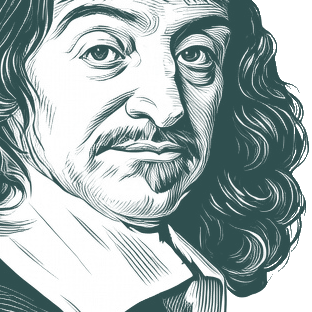
René Descartes (March 31, 1596 – February 11, 1650) was a highly influential French philosopher, mathematician, physicist and writer. He is known for his influential arguments for substance dualism, where mind and body are considered to have distinct essences, one being characterized by thought, the other by spatial extension. He has been dubbed the "Father of Modern Philosophy" and the "Father of Modern Mathematics." He is also known as Cartesius.
Biography information from
Wikiquote·
Portrait adapted from
Wikimedia Commons, After Frans Hals (Public domain / CC0)
Il est bon de savoir quelque chose des moeurs de divers peuples, afin de juger des notres plus sainement et que nous ne pensions pas que tout ce qui est contre nos modes soit ridicule et contre raison, ainsi qu'ont coutume de faire ceux qui n'ont rien vu; mais lorsqu'on emploie trop de temps à voyager on devient enfin étranger en son pays; et lorsqu'on est trop curieux des choses qui se pratiquaient aux siècles passés, on demeure ordinairement fort ignorant de celles qui se pratiquent en celui-ci.
Porque por naturaleza, considerada en general, no entiendo otra cosa sino Dios mismo, o bien el orden y la disposición que Dios ha establecido en las cosas creadas. Y por mi naturaleza en particular, no entiendo otra cosa sino la complexión o reunión de todo aquello que Dios me ha dado.
Works in ChatGPT, Claude, or Any AI
Add semantic quote search to your AI assistant via MCP. One command setup.
I knew that the languages which one learns there are necessary to understand the works of the ancients; and that the delicacy of fiction enlivens the mind; that famous deeds of history ennoble it and, if read with understanding, aid in maturing one's judgment; that the reading of all the great books is like conversing with the best people of earlier times; it is even studied conversation in which the authors show us only the best of their thoughts; that eloquence has incomparable powers and beauties; that poetry has enchanting delicacy and sweetness; that mathematics has very subtle processes which can serve as much to satisfy the inquiring mind as to aid all the arts and diminish man's labor; that treatises on morals contain very useful teachings and exhortations to virtue; that theology teaches us how to go to heaven; that philosophy teaches us to talk with appearance of truth about things, and to make ourselves admired by the less learned; that law, medicine, and the other sciences bring honors and wealth to those who pursue them; and finally, that it is desirable to have examined all of them, even to the most superstitious and false in order to recognize their real worth and avoid being deceived thereby