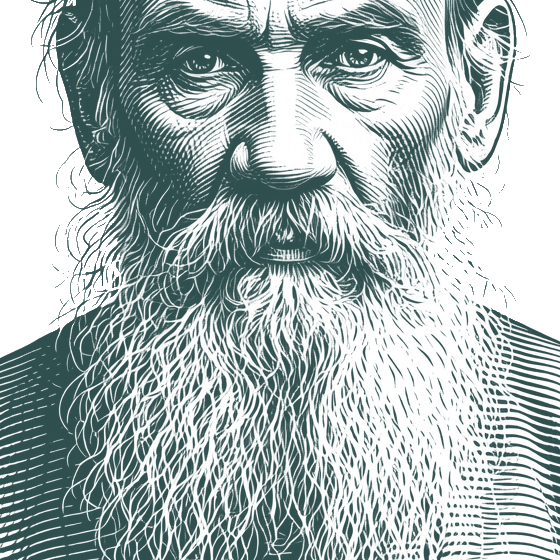
When I started life Hegelianism was the basis of everything: it was in the air, found expression in magazine and newspaper articles, in novels and es… - Leo Tolstoy
""
When I started life Hegelianism was the basis of everything: it was in the air, found expression in magazine and newspaper articles, in novels and essays, in art, in histories, in sermons, and in conversation. A man unacquainted with Hegel had no right to speak: he who wished to know the truth studied Hegel. Everything rested on him; and suddenly forty years have gone by and there is nothing left of him, he is not even mentioned — as though he had never existed. And what is most remarkable is that, like pseudo-Christianity, Hegelianism fell not because anyone refuted it, but because it suddenly became evident that neither the one nor the other was needed by our learned, educated world.
English
Collect this quote
About
Leo Tolstoy
Lev Nikolayevitch Tolstoy [Ле́в Никола́евич Толсто́й, usually rendered Leo Tolstoy, or sometimes Tolstoi] (9 September 1828 – 20 November 1910) was a Russian writer, philosopher and social activist (social critic), whose novels War and Peace and Anna Karenina are internationally praised classics of world literature. He was a major influence on the development of Christian anarchism and pacifism, contributing to such nonviolent resistance movements as those of Mahatma Gandhi, Martin Luther King, Jr., and James Bevel.
Biography information from
Wikiquote·
Portrait adapted from
Wikimedia Commons, Sergei Prokudin-Gorskii (Public domain / CC0)
Also Known As
Pen Names:
Л. Н. Т.
•
Л. Н.
Birth Name:
Lev Nikolayevich Tolstoy
Native Name:
Лев Никола́евич Толсто́й
Alternative Names:
Count Lev Nikolayevich Tolstoy
•
Tolstoy, Leo, graf, 1828-1910
•
Tolstoĭ, Lev Nikolaevich, graf, 1828-1910
•
Lev Nikolayevich Tolstoĭ
•
Leo Tolstoi
•
Tolstoĭ, Lev Nikolaevich, graf
•
Tolstoy, Leo, graf
To be good and lead a good life means to give to others more than one takes from them.
But our idea is that the wolves should be fed and the sheep kept safe.
Try QuoteGPT
Chat naturally about what you need. Each answer links back to real quotes with citations.
"People of limited intelligence are fond of talking about "these days," imagining that they have discovered and appraised the peculiarities of "these days" and that human nature changes with the times."