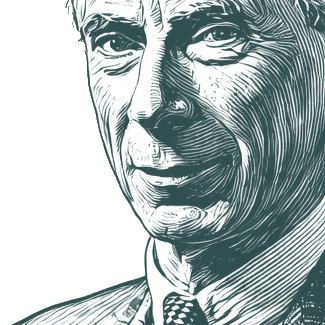
I would never die for my beliefs because I might be wrong. - Bertrand Russell

" "

I would never die for my beliefs because I might be wrong.

English
Collect this quote

About Bertrand Russell

Bertrand Arthur William Russell, 3rd Earl Russell (May 18, 1872 – February 2, 1970) was a British philosopher, logician, mathematician, historian, and social critic. In 1950, he was awarded a Nobel Prize in Literature.

Biography information from Wikiquote

Also Known As

Birth Name: Bertrand Arthur William Russell
Alternative Names: Bertrand Russell, 3rd Earl Russell Bertrand Russell, Earl Russell Bertrand Arthur William Russell, 3rd Earl Russell Russell
PREMIUM FEATURE
Advanced Search Filters

Filter search results by source, date, and more with our premium search tools.

Related quotes. More quotes will automatically load as you scroll down, or you can use the load more buttons.

Additional quotes by Bertrand Russell

Man differs from other animals in one very important respect, and that is that he has some desires which are, so to speak, infinite, which can never be fully gratified, and which would keep him restless even in Paradise. The boa constrictor, when he has had an adequate meal, goes to sleep, and does not wake until he needs another meal. Human beings, for the most part, are not like this.

Modern industry, in fact, is a kind of rape. All the long astronomical and geological ages during which the materials which we find useful have been built up, contribute a moment's blaze, a moment's frivolous exuberance. But when his fireworks are finished, what will become of industrial man? All this, of course, does not appear in practice in the tragic and catastrophic form in which I have been stating it. What we know is that the price of coal goes up, and we do not readily connect this fact with the second law of thermodynamics. If you look up this law in a textbook, you will learn that it states that entropy always increases, and if you are not a physicist you will not be much the wiser. But the law can be stated more simply, and is stated more simply by proverbial wisdom. It states, in fact, that you cannot unscramble eggs. It deals with all the irreversible processes of nature. Some processes are reversible, some are not. If you travel from London to Edinburgh, you can also travel from Edinburgh to London, but if coal is used to make your train go, there is no way by which you can collect the heat which it generates, and turn it back into coal. If you shuffle a pack of cards, you can, if you take enough trouble, unshuffle them again, but if you drop a drop of ink into a glass of water, the ink will gradually spread throughout the water, and there is no way by which you can collect it back again into a drop. All industry depends upon such irreversible processes; it all uses up the earth's capital. Modern industry is, in fact, a spendthrift, and sooner or later must suffer the penalty of spendthrifts.

Unlimited Quote Collections

Organize your favorite quotes without limits. Create themed collections for every occasion with Premium.

Those who advocate common usage in philosophy sometimes speak in a manner that suggests the mystique of the 'common man.' They may admit that in organic chemistry there is need of long words, and that quantum physics requires formulas that are difficult to translate into ordinary English, but philosophy (they think) is different. It is not the function of philosophy – so they maintain – to teach something that uneducated people do not know; on the contrary, its function is to teach superior persons that they are not as superior as they thought they were, and that those who are really superior can show their skill by making sense of common sense. No one wants to alter the language of common sense, any more than we wish to give up talking of the sun rising and setting. But astronomers find a different language better, and I contend that a different language is better in philosophy. Let us take an example, that of perception. There is here an admixture of philosophical and scientific questions, but this admixture is inevitable in many questions, or, if not inevitable, can only be avoided by confining ourselves to comparatively unimportant aspects of the matter in hand. Here is a series of questions and answers. Q. When I see a table, will what I see be still there if I shut my eyes? A. That depends upon the sense in which you use the word 'see.' Q. What is still there when I shut my eyes? A. This is an empirical question. Don't bother me with it, but ask the physicists. Q. What exists when my eyes are open, but not when they are shut? A. This again is empirical, but in deference to previous philosophers I will answer you: colored surfaces. Q. May I infer that there are two senses of 'see'? In the first, when I 'see' a table, I 'see' something conjectural about which physics has vague notions that are probably wrong. In the second, I 'see' colored surfaces which cease to exist when I shut my eyes. A. That is correct if you want to think clearly, but our philosophy makes clear thinking unnecessary. By oscillating between the two meanings, we avoid paradox and shock, which is more than most philosophers do.

Loading...