The setters up, therefore, and the advocates of the Christian system of faith, could not but foresee that the continually progressive knowledge that … - Thomas Paine
""
The setters up, therefore, and the advocates of the Christian system of faith, could not but foresee that the continually progressive knowledge that man would gain by the aid of science, of the power and wisdom of God, manifested in the structure of the universe, and in all the works of creation, would militate against, and call into question, the truth of their system of faith; and therefore it became necessary to their project, and this they effected by restricting the idea of learning to the dead study of dead languages.
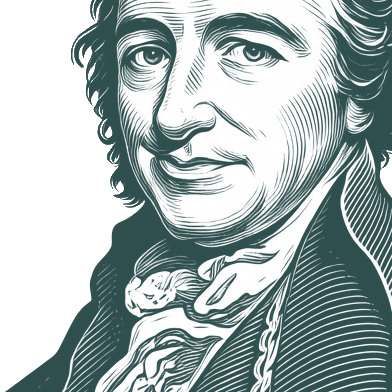
Thomas Paine (February 9, 1737 [O.S. January 29, 1736] – 8 June 1809) was a British-American political writer, theorist, and activist who had a great influence on the thoughts and ideas which led to the American Revolution and the United States Declaration of Independence. He wrote three of the most influential and controversial works of the 18th Century: Common Sense, Rights of Man, and The Age of Reason. His ideas reflected Enlightenment-era ideals of transnational human rights.
Biography information from
Wikiquote·
Portrait adapted from
Wikimedia Commons, Auguste Millière / After George Romney / After William Sharp (Public domain / CC0)
Portrait from Wikimedia Commons. Credit: Auguste Millière / After George Romney / After William Sharp. Used under Public domain / CC0. Processed and styled by Quotewise.
Go Premium
Support Quotewise while enjoying an ad-free experience and premium features.
The Grecians and Romans were strongly possessed of the spirit of liberty but not the principle, for at the time that they were determined not to be slaves themselves, they employed their power to enslave the rest of mankind.
It is of the utmost danger to society to make it (religion) a party in political disputes.
U zult me toch willen nageven dat ik altijd sterk heb benadrukt dat elk mens het recht heeft op een eigen mening, hoezeer die mening ook van de mijne afwijkt. Hij die een ander dit recht ontzegt, maakt zichzelf tot slaaf van zijn huidige mening, omdat hij zichzelf dan het recht ontneemt deze te veranderen.