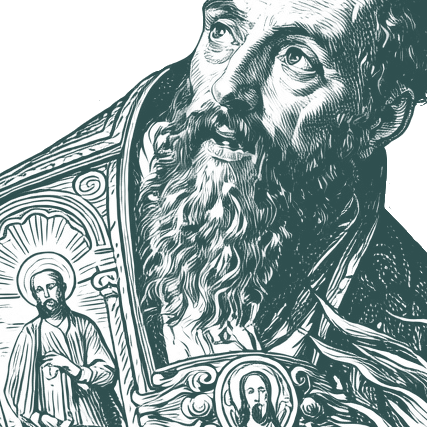
I have read in Plato and Cicero sayings that are very wise and very beautiful; but I never read in either of them, "Come unto me, all ye that labor a… - Augustine of Hippo
""
I have read in Plato and Cicero sayings that are very wise and very beautiful; but I never read in either of them, "Come unto me, all ye that labor and are heavy laden."
St. Augustine of Hippo (13 November 354 – 28 August 430) was a Christian theologian, rhetor, North African bishop, Doctor of the Catholic Church, saint, and a philosopher influenced in his early years by Manichaeism and the Neo-Platonism of Plotinus.
Biography information from
Wikiquote·
Portrait adapted from
Wikimedia Commons, Philippe de Champaigne (Public domain / CC0)
Also Known As
Native Name:
Aurelius Augustinus
Alternative Names:
Saint Augustine
•
Saint Austin
•
Augustine
•
St. Augoustinos
•
St. Augustine of Hippo
•
Aurelius Augustine
•
Aurelius Augustinus Hipponensis
•
St. Augustine
•
Augustinus
•
Saint Augustine of Hippo
•
Augustinus, Aurelius
•
bishop of Hippo
We may not assent to the teaching even of the Catholic bishops, if at any time they are deceived into opinions contrary to the canonical Scriptures of God; but if they should so fall into error, and yet maintain the bond of unity and charity, let the apostle's saying avail in their case: 'And if in anything ye are otherwise minded, God shall reveal even this unto you.' Now these divine words have so manifest an application to the whole Church, that none but heretics in their stubborn perverseness and blind fury can bark against them. (Cf. Augustine's Reply to Faustus the Manichaean (Contra Faustum), book 11, 5 )
Since He is the Mediator of God and men, the man Christ Jesus has been made Head of the Church, and the faithful are His members. Wherefore He says: "For them I hallow Myself" (John 17:19). But when He says, "For them I hallow Myself," what else can He mean but this: "I sanctify them in Myself, since truly they are Myself"? For, as I have remarked, they of whom He speaks are His members, and the Head of the body are one Christ. … That He signifies this unity is certain from the remainder of the same verse. For having said, "For them I hallow Myself," He immediately adds, "in order that they too may be hallowed in truth," to show that He refers to the holiness that we are to receive in Him. Now the words "in truth" can only mean "in Me," since Truth is the Word who in the beginning was God. The Son of man was Himself sanctified in the Word as the moment of His creation, when the Word was made flesh, for Word and man became one Person. It was therefore in that instant that He hallowed Himself in Himself; that is, He hallowed Himself as man, in Himself as the Word. For there is but one Christ, Word and man, sanctifying the man in the Word. But now it is on behalf of His members that He adds: "and for them I hallow Myself." That is to say, that since they too are Myself, so they too may profit by this sanctification just as I profited by it as man without them. "And for them I hallow Myself"; that is, I sanctify them in Myself as Myself, since in Me they too are Myself. "In order that they too may be hallowed in truth." What do the words "they too" mean, if not that thy may be sanctified as I am sanctified; that is to say, "in truth," which is I Myself? [Quia et ipsi sunt ego. "Since they too are myself"]
Works in ChatGPT, Claude, or Any AI
Add semantic quote search to your AI assistant via MCP. One command setup.