president of the United States from 2009 to 2017 (born 1961)
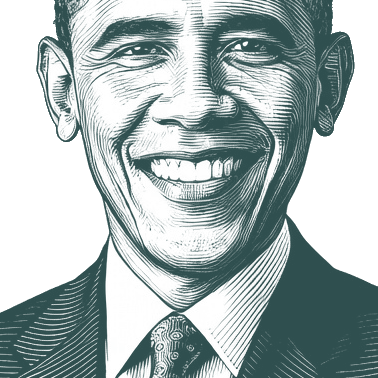
Barack Hussein Obama II (born August 4, 1961) is an American politician who served as the 44th president of the United States of America from 2009 to 2017. Born in Hawaii, the son of a Kenyan father and a mother from Kansas, he won the 2008 presidential election and was re-elected president in November 2012. A member of the U.S. Democratic Party, he was the first African American president. Before becoming president, he represented the 13th district for three terms in the Illinois Senate from 1997 to 2004 and served as United States senator from Illinois between January 4, 2005 and November 16, 2008. While president, he was the recipient of the 2009 Nobel Peace Prize.
Bio from: Wikiquote (CC BY-SA 4.0) · Portrait adapted from: Wikimedia Commons, Official White House Photo by Pete Souza (Public domain / CC0)
From Wikidata (CC0)

"For we have a choice in this country. We can accept a politics that breeds division, and conflict, and cynicism. We can tackle race only as spectacle-as we did in the OJ trial-or in the wake of tragedy, as we did in the aftermath of Katrina-or as a fodder for the nightly news. We can play Reverend Wright's sermons on every channel, every day and talk about them from now until the election, and make the only question in this campaign whether or not the American people think that I somehow believe or sympathize with his most offensive words. We can pounce on some gaffe by a Hillary supporter as evidence that she's playing the race card, or we can speculate on whether white men will all flock to John McCain the general election regardless of his policies.
We can do that.
But if we do, I can tell you that in the next election, we'll be talking about some other distraction. And then another one. And then another one. And nothing will change.
That is one option. Or, at this moment, in this election, we can come together and say, "Not this time.
The stakes involved in Washington policy debates are often so high — whether we send our young men and women to war; whether we allow stem cell research to go forward — that even small differences in perspective are magnified. The demands of party loyalty, the imperative of campaigns, and the amplification of conflict by the media all contribute to an atmosphere of suspicion. Moreover, most people who serve in Washington have been trained either as lawyers or as political operatives — professions that tend to place a premium on winning arguments rather than solving problems. I can see how, after a certain amount of time in the capital, it becomes tempting to assume that those who disagree with you have fundamentally different values — indeed, that they are motivated by bad faith, and perhaps are bad people.
It is the kindness to take in a stranger when the levees break; the selflessness of workers who would rather cut their hours than see a friend lose their job which sees us through our darkest hours. It is the firefighter's courage to storm a stairway filled with smoke, but also a parent's willingness to nurture a child, that finally decides our fate.
"For half of the world's population, roughly three billion people around the world living on less than two dollars a day, an election is at best a means, not an end; a starting point, not deliverance. These people are looking less for an "electocracy" than for the basic elements that for most of us define a decent life — food, shelter, electricity, basic health care, education for their children, and the ability to make their way through life without having to endure corruption, violence, or arbitrary power."