Every November of my boyhood, we put on red poppies and attended highly patriotic services in remembrance of those who had 'given' their lives. But on what assurance did we know that these gifts had really been made? Only the survivors — the living — could attest to it. In order to know that a person had truly laid down his life for his friends, or comrades, one would have to hear it from his own lips, or at least have heard it promised in advance. And that presented another difficulty. Many brave and now dead soldiers had nonetheless been conscripts. The known martyrs — those who actually, voluntarily sought death and rejoiced in the fact — had been the kamikaze pilots, immolating themselves to propitiate a 'divine' emperor who looked (as Orwell once phrased it) like a monkey on a stick. Their Christian predecessors had endured torture and death (as well as inflicted it) in order to set up a theocracy. Their modern equivalents would be the suicide murderers, who mostly have the same aim in mind. About people who set out to lose their lives, then, there seems to hang an air of fanaticism: a gigantic sense of self-importance unattractively fused with a masochistic tendency to self-abnegation. Not wholesome.
The better and more realistic test would therefore seem to be: In what cause, or on what principle, would you risk your life?
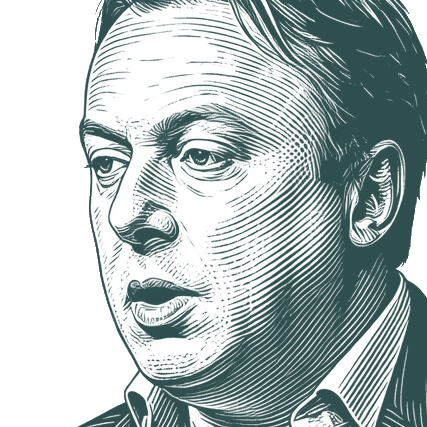
English American author and journalist (1949–2011)
Christopher Eric Hitchens (13 April 1949 – 15 December 2011) was an-English-American journalist and writer. He contributed to the New Statesman, The Nation, The Atlantic, London Review of Books, The Times Literary Supplement, Slate, and Vanity Fair. Hitchens was the author, co-author, editor or co-editor of over 30 books, including five collections of essays, on a range of subjects, including politics, literature, and religion. A staple of talk shows and lecture circuits, his confrontational style of debate made him both a lauded and controversial figure and public intellectual.
Bio from: Wikiquote (CC BY-SA 4.0) · Portrait adapted from: Wikimedia Commons, ensceptico (CC BY)
Birth Name:
Christopher Eric Hitchens
Also Known As:
Hitch
From Wikidata (CC0)
Showing quotes in randomized order to avoid selection bias. Click Popular for most popular quotes.
Gore Vidal, for instance, once languidly told me that one should never miss a chance either to have sex or to appear on television. My efforts to live up to this maxim have mainly resulted in my passing many unglamorous hours on off-peak cable TV. It was actually Vidal's great foe William F. Buckley who launched my part-time television career, by inviting me on to Firing Line when I was still quite young, and giving me one of the American Right's less towering intellects as my foil. The response to the show made my day, and then my week. Yet almost every time I go to a TV studio, I feel faintly guilty. This is pre-eminently the 'soft' world of dream and illusion and 'perception': it has only a surrogate relationship to the 'hard' world of printed words and written-down concepts to which I've tried to dedicate my life, and that surrogate relationship, while it, too, may be 'verbal,' consists of being glib rather than fluent, fast rather than quick, sharp rather than pointed. It means reveling in the fact that I have a meretricious, want-it-both-ways side. My only excuse is to say that at least I do not pretend that this is not so.
Nobody knows how many North Koreans have died or are dying in the famine — some estimates by foreign-aid groups run as high as three million in the period from 1995 to 1998 alone — but the rotund, jowly face of Kim Il Sung still beams down contentedly from every wall, and the 58-year-old son looks as chubby as ever, even as his slenderized subjects are mustered to applaud him.
In other words, that the discussion about what is good, what is beautiful, what is noble, what is pure, and what is true could always go on. Why is that important? Why would I like to do that? Because that’s the only conversation worth having. And whether it goes on or not after I die, I don’t know. But, I do know that it is the conversation I want to have while I am still alive. Which means that to me the offer of certainty, the offer of complete security, the offer of an impermeable faith that can’t give way is an offer of something not worth having. I want to live my life taking the risk all the time that I don’t know anything like enough yet… that I haven’t understood enough… that I can’t know enough… that I am always hungrily operating on the margins of a potentially great harvest of future knowledge and wisdom. I wouldn’t have it any other way. And I’d urge you to look at those who tell you, those people who tell you at your age, that you are dead until you believe as they do. What a terrible thing to be telling to children. …and that you can only live by accepting an absolute authority. Don’t think of that as a gift. Think of it as a poisoned chalice. Push it aside however tempting it is. Take the risk of thinking for yourself. Much more happiness, truth, beauty and wisdom will come to you that way.
The only position that leaves me with no cognitive dissonance is atheism. It is not a creed. Death is certain, replacing both the siren-song of Paradise and the dread of Hell. Life on this earth, with all its mystery and beauty and pain, is then to be lived far more intensely: we stumble and get up, we are sad, confident, insecure, feel loneliness and joy and love. There is nothing more; but I want nothing more.
Their [<nowiki/>antiwar movement] mantra was: "Afghanistan, where the world's richest country rains bombs on the world's poorest country." Poor fools. They should never have tried to beat me at this game. What about, "Afghanistan, where the world's most open society confronts the world's most closed one"? "Where American women pilots kill the men who enslave women." "Where the world's most indiscriminate bombers are bombed by the world's most accurate ones." "Where the largest number of poor people applaud the bombing of their own regime." I could go on. (I think No. 4 may need a little work.) But there are some suggested contrasts for the "doves" to paste into their scrapbook. Incidentally, when they look at their scrapbooks they will be able to reread themselves saying things like, "The bombing of Kosovo is driving the Serbs into the arms of Milosevic."
Many readers are familiar with the spirit and the letter of the definition of “prayer”, as given by Ambrose Bierce in his Devil’s Dictionary. It runs like this, and is extremely easy to comprehend: Prayer: A petition that the laws of nature be suspended in favor of the petitioner; himself confessedly unworthy.
Everybody can see the joke that is lodged within this entry: The man who prays is the one who thinks that god has arranged matters all wrong, but who also thinks that he can instruct god how to put them right. Half–buried in the contradiction is the distressing idea that nobody is in charge, or nobody with any moral authority. The call to prayer is self–cancelling. Those of us who don’t take part in it will justify our abstention on the grounds that we do not need, or care, to undergo the futile process of continuous reinforcement. Either our convictions are enough in themselves or they are not: At any rate they do require standing in a crowd and uttering constant and uniform incantations. This is ordered by one religion to take place five times a day, and by other monotheists for almost that number, while all of them set aside at least one whole day for the exclusive praise of the Lord, and Judaism seems to consist in its original constitution of a huge list of prohibitions that must be followed before all else. The tone of the prayers replicates the silliness of the mandate, in that god is enjoined or thanked to do what he was going to do anyway. Thus the Jewish male begins each day by thanking god for not making him into a woman (or a Gentile), while the Jewish woman contents herself with thanking the almighty for creating her “as she is.” Presumably the almighty is pleased to receive this tribute to his power and the approval of those he created. It’s just that, if he is truly almighty, the achievement would seem rather a slight one. Much the same applies to the idea that prayer, instead of making Christianity look foolish, makes it appear convincing. Now,
Enhance Your Quote Experience
Enjoy ad-free browsing, unlimited collections, and advanced search features with Premium.
The fervor and single-mindedness of this deification probably have no precedent in history. It's not like Duvalier or Assad passing the torch to the son and heir. It surpasses anything I have read about the Roman or Babylonian or even Pharaonic excesses. An estimated $2.68 billion was spent on ceremonies and monuments in the aftermath of Kim Il Sung's death. The concept is not that his son is his successor, but that his son is his reincarnation. North Korea has an equivalent of Mount Fuji — a mountain sacred to all Koreans. It's called Mount Paekdu, a beautiful peak with a deep blue lake, on the Chinese border. Here, according to the new mythology, Kim Jong Il was born on February 16, 1942. His birth was attended by a double rainbow and by songs of praise (in human voice) uttered by the local birds. In fact, in February 1942 his father and mother were hiding under Stalin's protection in the dank Russian city of Khabarovsk, but as with all miraculous births it's considered best not to allow the facts to get in the way of a good story.