Our belief is not a belief. Our principles are not a faith. We do not rely soley upon science and reason, because these are necessary rather than sufficient factors, but we distrust anything that contradicts science or outrages reason. We may differ on many things, but what we respect is free inquiry, openmindedness, and the pursuit of ideas for their own sake.
English American author and journalist (1949–2011)
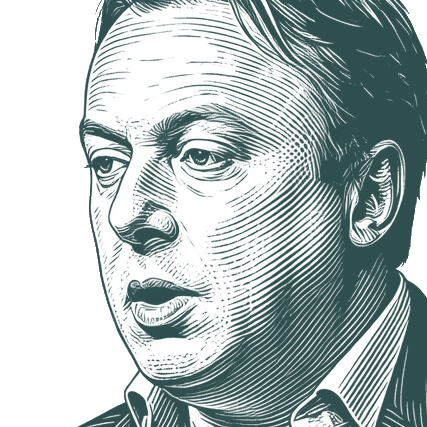
Christopher Eric Hitchens (13 April 1949 – 15 December 2011) was an-English-American journalist and writer. He contributed to the New Statesman, The Nation, The Atlantic, London Review of Books, The Times Literary Supplement, Slate, and Vanity Fair. Hitchens was the author, co-author, editor or co-editor of over 30 books, including five collections of essays, on a range of subjects, including politics, literature, and religion. A staple of talk shows and lecture circuits, his confrontational style of debate made him both a lauded and controversial figure and public intellectual.
Bio from: Wikiquote (CC BY-SA 4.0) · Portrait adapted from: Wikimedia Commons, ensceptico (CC BY)
Birth Name:
Christopher Eric Hitchens
Also Known As:
Hitch
From Wikidata (CC0)
To be the father of growing daughters is to understand something of what Yeats evokes with his imperishable phrase 'terrible beauty.' Nothing can make one so happily exhilarated or so frightened: it's a solid lesson in the limitations of self to realize that your heart is running around inside someone else's body. It also makes me quite astonishingly calm at the thought of death: I know whom I would die to protect and I also understand that nobody but a lugubrious serf can possibly wish for a father who never goes away.
Try QuoteGPT
Chat naturally about what you need. Each answer links back to real quotes with citations.
One must state it plainly. Religion comes from the period of human prehistory where nobody — not even the mighty Democritus who concluded that all matter was made from atoms — had the smallest idea what was going on. It comes from the bawling and fearful infancy of our species, and is a babyish attempt to meet our inescapable demand for knowledge (as well as for comfort, reassurance and other infantile needs). Today the least educated of my children knows much more about the natural order than any of the founders of religion, and one would like to think — though the connection is not a fully demonstrable one — that this is why they seem so uninterested in sending fellow humans to hell.
Alcohol makes other people less tedious, and food less bland, and can help provide what the Greeks called entheos, or the slight buzz of inspiration when reading or writing. The only worthwhile miracle in the New Testament — the transmutation of water into wine during the wedding at Cana — is a tribute to the persistence of Hellenism in an otherwise austere Judaea. The same applies to the seder at Passover, which is obviously modeled on the Platonic symposium: questions are asked (especially of the young) while wine is circulated. No better form of sodality has ever been devised: at Oxford one was positively expected to take wine during tutorials. The tongue must be untied. It's not a coincidence that Omar Khayyam, rebuking and ridiculing the stone-faced Iranian mullahs of his time, pointed to the value of the grape as a mockery of their joyless and sterile regime. Visiting today's Iran, I was delighted to find that citizens made a point of defying the clerical ban on booze, keeping it in their homes for visitors even if they didn't particularly take to it themselves, and bootlegging it with great brio and ingenuity. These small revolutions affirm the human.
Enhance Your Quote Experience
Enjoy ad-free browsing, unlimited collections, and advanced search features with Premium.
I once spoke to someone who had survived the genocide in Rwanda, and she said to me that there was now nobody left on the face of the earth, either friend or relative, who knew who she was. No one who remembered her girlhood and her early mischief and family lore; no sibling or boon companion who could tease her about that first romance; no lover or pal with whom to reminisce. All her birthdays, exam results, illnesses, friendships, kinships — gone. She went on living, but with a tabula rasa as her diary and calendar and notebook. I think of this every time I hear of the callow ambition to 'make a new start' or to be 'born again': Do those who talk this way truly wish for the slate to be wiped? Genocide means not just mass killing, to the level of extermination, but mass obliteration to the verge of extinction. You wish to have one more reflection on what it is to have been made the object of a 'clean' sweep? Try Vladimir Nabokov's microcosmic miniature story 'Signs and Symbols,' which is about angst and misery in general but also succeeds in placing it in what might be termed a starkly individual perspective. The album of the distraught family contains a faded study of Aunt Rosa, a fussy, angular, wild-eyed old lady, who had lived in a tremulous world of bad news, bankruptcies, train accidents, cancerous growths — until the Germans put her to death, together with all the people she had worried about.