American fiction writer and essayist (1962–2008)
David Foster Wallace (21 February 1962 – 12 September 2008) was an American novelist, essayist, and short story writer. His works include The Broom of the System (novel), Infinite Jest (novel), The Girl With Curious Hair (short story collection), Brief Interviews with Hideous Men (short story collection), A Supposedly Fun Thing I'll Never Do Again (essay collection), and the posthumously-published The Pale King (novel) and Both Flesh and Not (essay collection).
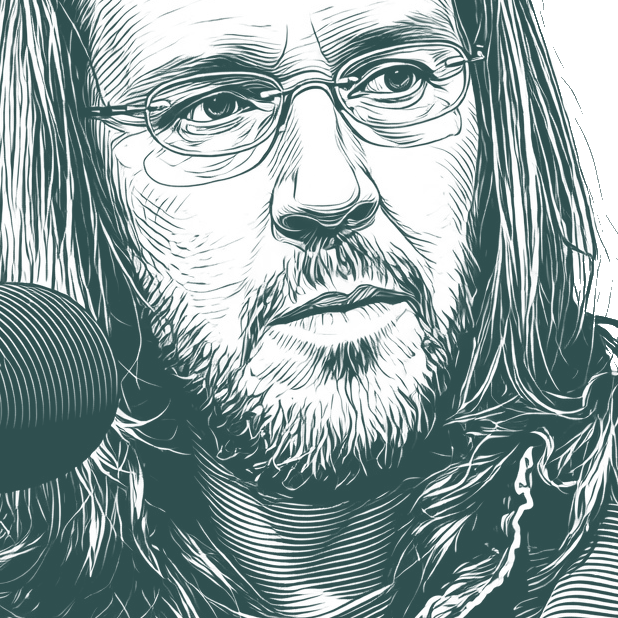
Bio from: Wikiquote (CC BY-SA 4.0) · Portrait adapted from: Wikimedia Commons, Steve Rhodes (CC BY)
From Wikidata (CC0)

The boy, who did everything well and with a natural unslumped grace the wraith himself had always lacked, and whom the wraith had been so terribly eager to see and hear and let him (the son) know he was seen and heard, the son had become a steadily more and more hidden boy, toward the wraith's life's end; and no one else in the wraith and the boy's nuclear family would see or acknowledge this, the fact that the graceful and marvelous boy was disappearing, right before their eyes. They looked but did not see his invisibility.
Kate Gompert’s always thought of this anhedonic state as a kind of radical abstracting of everything, a hollowing out of stuff that used to have affective content. Terms the undepressed toss around and take for granted as full and fleshy — happiness, joie de vivre, preference, love — are stripped to their skeletons and reduced to abstract ideas. They have, as it were, denotation but not connotation. The anhedonic can still speak about happiness and meaning et al., but she has become incapable of feeling anything in them, of understanding anything about them, of hoping anything about them, or of believing them to exist as anything more than concepts. Everything becomes an outline of the thing. Objects become schemata. The world becomes a map of the world. An anhedonic can navigate, but has no location. I.e. the anhedonic becomes, in the lingo of Boston AA, Unable To Identify.
You burn to have your photograph in a tennis magazine.”
“I’m afraid so.”
“Why again exactly, now?”
“I guess to be felt about as I feel about those players with their pictures in magazines.”
“Why?”
“Why? I guess to give my life some sort of meaning, Lyle.”
“And how would this do this again?”
“Lyle, I don’t know. I do not know. It just does. Would. Why else would I burn like this, clip secret pictures, not take risks, not sleep or pee?”
“You feel these men with their photographs in magazines care deeply about having their photographs in magazines. Derive immense meaning.”
“I do. They must. I would. Else why would I burn like this to feel as they feel?”
“The meaning they feel, you mean. From the fame.”
“Lyle, don’t they?”
“LaMont, perhaps they did at first. The first photograph, the first magazine, the gratified surge, the seeing themselves as others see them, the hagiography of image, perhaps. Perhaps the first time: enjoyment. After that, do you trust me, trust me: they do not feel what you burn for. After the first surge, they care only that their photographs seem awkward or unflattering, or untrue, or that their privacy, this thing you burn to escape, what they call their privacy is being violated. Something changes. After the first photograph has been in a magazine, the famous men do not enjoy their photographs in magazines so much as they fear that their photographs will cease to appear in magazines. They are trapped, just as you are.”
“Is this supposed to be good news? This is awful news.”
“LaMont, are you willing to listen to a Remark about what is true?”
“Okey-dokey.”
“The truth will set you free. But not until it is finished with you.”
“Maybe I ought to be getting back.”
“LaMont, the world is very old. You have been snared by something untrue. You are deluded. But this is good news. You have been snared by the delusion that envy has a reciprocal. You assume that there is a flip-side to your painful envy of Michael Chang: namely Michael Chang
Try QuoteGPT
Chat naturally about what you need. Each answer links back to real quotes with citations.
....the Crocodiles say they can't even begin to say how many new guys they've seen Come In and then get sucked back Out There, Come In to AA for a while and Hang In and put together a little sober time and have things start to get better, head-wise and life-quality-wise, and after a while the new guys get cocky, they decide they've gotten `Well,' and they get really busy at the new job sobriety's allowed them to get, or maybe they buy season Celtics tickets, or they rediscover pussy and start chasing pussy (these withered gnarled toothless totally post-sexual old fuckers actually say pussy), but one way or another these poor cocky clueless new bastards start gradually drifting away from rabid Activity In The Group, and then away from their Group itself, and then little by little gradually drift away from any AA meetings at all, and then, without the protection of meetings or a Group, in time — oh there's always plenty of time, the Disease is fiendishly patient — how in time they forget what it was like, the ones that've cockily drifted, they forget who and what they are, they forget about the Disease, until like one day they're at like maybe a Celtics-Sixers game, and the good old Fleet/First Interstate Center's hot, and they think what could just one cold foamer hurt, after all this sober time, now that they've gotten `Well.' Just one cold one. What could it hurt. And after that one it's like they'd never stopped, if they've got the Disease. And how in a month or six months or a year they have to Come Back In, back to the Boston AA halls and their old Group, tottering, D.T.ing, with their faces hanging down around their knees all over again, or maybe it's five or ten years before they can get it up to get back In, beaten to shit again, or else their system isn't ready for the recurred abuse again after some sober time and they die Out There — the Crocodiles are always talking in hushed, 'Nam-like tones about Out There — or else, worse, maybe they kill somebody in a
There are all different kinds of freedom, and the kind that is most precious you will not hear much talked about in the great outside world of winning and achieving and displaying. The really important kind of freedom involves attention, and awareness, and discipline, and effort, and being able truly to care about other people and to sacrifice for them, over and over, in myriad petty little unsexy ways, every day. That is real freedom. The alternative is unconsciousness, the default setting, the 'rat race' - the constant gnawing sense of having had and lost some infinite thing.