Portuguese poet, writer, and philosopher (1888–1935); creator of the heteronymic system including Alberto Caeiro, Ricardo Reis, Álvaro de Campos, and Bernardo Soares
Fernando Pessoa (13 June 1888 – 30 November 1935) was a Portuguese poet and writer, most of whose work was published posthumously. He wrote frequently under heteronyms, alter egos with developed personalities, biographies, jobs, habits, attitudes, addresses, etc., who sometimes quoted and interacted with each other and other people.
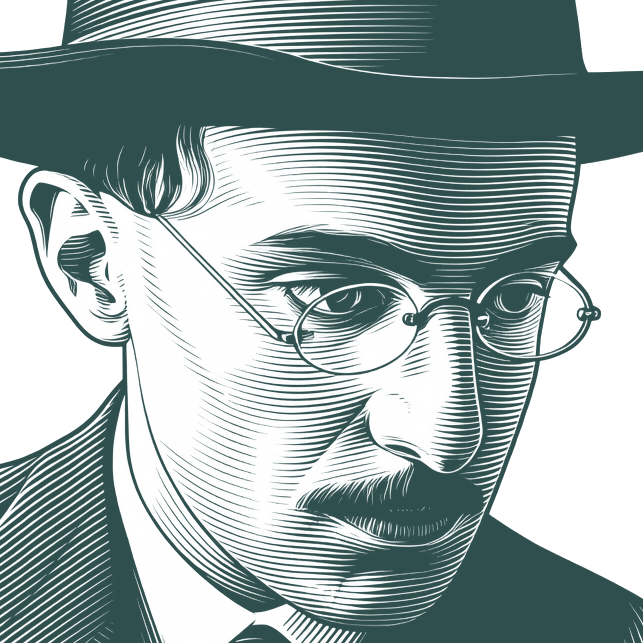
Bio from: Wikiquote (CC BY-SA 4.0) · Portrait adapted from: Wikimedia Commons, S.A. e Maria José de Lencastre (Public domain / CC0)
From Wikidata (CC0)

The blighter that is at the end of the sea
On the pitch-black night raised itself flying;
Round the vessel it flew three times,
Three times it flew creaking,
And said, 'Who dared pierce
Into my dens that I do not reveal,
My black ceilings of the end of the world?'
And the helmsman said, trembling,
'His Majesty King John the Second!' 'Whose sails are these then which I rub against?
Whose the keels I see and hear?'
Said the blighter, and rolled three times,
Three times it rolled filthy and bulky,
'Who attempts what is solely my power,
I who abide where no one ever could see me
And who drip the fears of the depthless sea?'
And the helmsman trembled, and said,
'His Majesty King John the Second!' Three times he raised his hands from the helm,
Three times he had them rooted on the helm,
And said after trembling three times,
'Here at the helm I am more than myself:
I am a People who wants the sea that is yours;
And more than the blighter, that my soul fears
And rolls on the darkness of the end of the world,
Orders the will, that ties me at the helm,
Of His Majesty King John the Second!'
Works in ChatGPT, Claude, or Any AI
Add semantic quote search to your AI assistant via MCP. One command setup.
Works in ChatGPT, Claude, or Any AI
Add semantic quote search to your AI assistant via MCP. One command setup.
Original: Paso tempos, passo silêncios, mudos sem forma passam por mim.
And leaning out the window, enjoying the day above the varying volume of the entire city, only one thought swells my soul – the intimate will to die, to finish, not to see more light over any city, not to think, not to feel, to leave behind like wrapping paper the course of the sun and the days, to rid myself, at the edge of the grand bed, as of a heavy suit, of the involuntary effort to be.
Let's adopt all the poses and gestures of something we aren't and don't wish to be, and don't even wish to be taken for being.
Let's buy books so as not to read them; let's go to concerts without caring to hear the music or see who's there; let's take long walks because we're sick of walking; and let's spend whole days in the country, just because it bores us. [23](Zenith trans.)