Indian spiritual philosopher, mystic, speaker and writer (1895–1986)
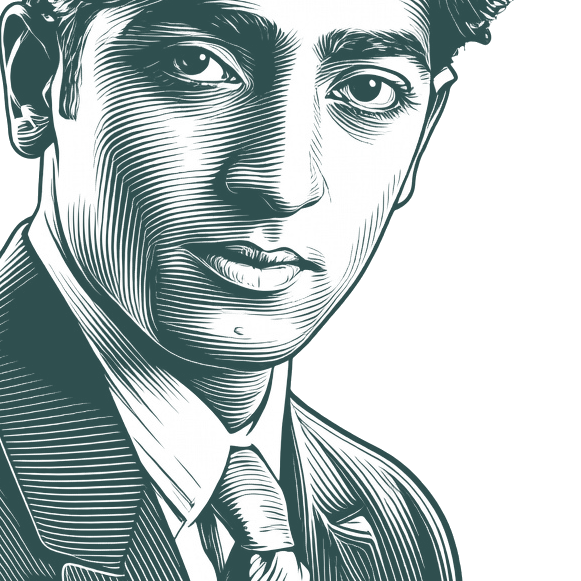
Jiddu Krishnamurti (11 May 1895 – 17 February 1986) was a spiritual teacher, public speaker, and writer, on psychological, sociological, and spiritual subjects.
Bio from: Wikiquote (CC BY-SA 4.0) · Portrait adapted from: Wikimedia Commons (Public domain / CC0)
From Wikidata (CC0)
To look is important. We look to immediate things and out of immediate necessities to the future, coloured by the past. Our seeing is very limited and our eyes are accustomed to near things.
Our look is as bound by time-space as our brain. We never look, we never see beyond this limitation; we do not know how to look through and beyond these fragmentary frontiers. But the eyes have to see beyond them, penetrating deeply and widely, without choosing, without shelter; they have to wander beyond man-made frontiers of ideas and values and to feel beyond love. Then there is a benediction which no god can give.
There is an efficiency inspired by love which goes far beyond and is much greater than the efficiency of ambition; and without love, which brings an integrated understanding of life, efficiency breeds ruthlessness. Is this not what is actually taking place all over the world? Our present education is geared to industrialization and war, its principal aim being to develop efficiency; and we are caught in this machine of ruthless competition and mutual destruction. If education leads to war, if it teaches us to destroy or be destroyed, has it not utterly failed?
The world accepts and follows the traditional approach. The primary cause of disorder in ourselves is the seeking of reality promised by another; we mechanically follow somebody who will assure us a comfortable spiritual life. It is a most extraordinary thing that although most of us are opposed to political tyranny and dictatorship, we inwardly accept the authority, the tyranny, of another to twist our minds and our way of life. So if we completely reject, not intellectually but actually, all so-called spiritual authority, all ceremonies, rituals and dogmas, it means that we stand alone and are already in conflict with society; we cease to be respectable human beings. A respectable human being cannot possibly come near to that infinite, immeasurable, reality.
Goodness shows itself in behaviour and action and in relationship. Generally our daily behaviour is based on either the following of certain patterns — mechanical and therefore superficial — or according to very carefully thought-out motive, based on reward or punishment. So our behaviour, consciously or unconsciously, is calculated. This is not good behaviour. When one realizes this, not merely intellectually or by putting words together, then out of this total negation comes true behaviour.
Man has throughout the ages been seeking something beyond himself, beyond material welfare — something we call truth or God or reality, a timeless state — something that cannot be disturbed by circumstances, by thought or by human corruption. Man has always asked the question: what is it all about? Has life any meaning at all? He sees the enormous confusion of life, the brutalities, the revolt, the wars, the endless divisions of religion, ideology and nationality, and with a sense of deep abiding frustration he asks, what is one to do, what is this thing we call living, is there anything beyond it?
What we call religion is merely organized belief, with its dogmas, rituals, mysteries and superstitions. Each religion has its own sacred book, its mediator, its priests and its ways of threatening and holding people.
Most of us have been conditioned to all this, which is considered religious education; but this conditioning sets man against man, it creates antagonism, not only among the believers, but also against those of other beliefs.
Though all religions assert that they worship God and say that we must love one another, they instill fear through their doctrines of reward and punishment, and through their competitive dogmas they perpetuate suspicion and antagonism.
I do not want to belong to any organization of a spiritual kind, please understand this. I would make use of an organization which would take me to London, for example; this is quite a different kind of organization, merely mechanical, like the post or the telegraph. I would use a motor car or a steamship to travel, these are only physical mechanisms which have nothing whatever to do with spirituality. Again, I maintain that no organization can lead man to spirituality.