German-born philosopher (1818-1883)
Karl Heinrich Marx (5 May 1818 – 14 March 1883) was a German political philosopher, economist, historian, sociologist, journalist and revolutionary socialist. Marx's work in economics laid the basis for labor theory of value, and has influenced much of subsequent economic thought. He published many works during his lifetime, including The Communist Manifesto (1848) and the first volume of Das Kapital (1867), the two later volumes being completed by his collaborator Friedrich Engels.
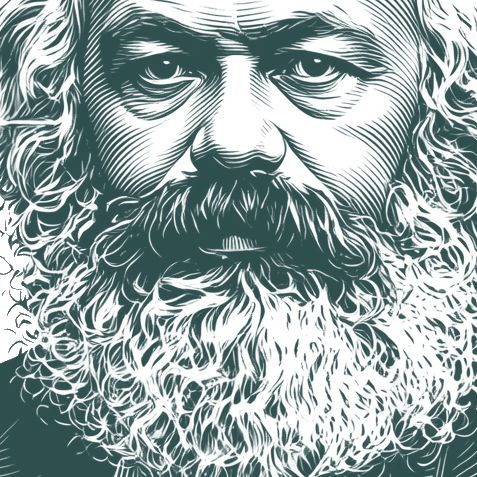
Bio from: Wikiquote (CC BY-SA 4.0) · Portrait adapted from: Wikimedia Commons, John Jabez Edwin Mayall (Public domain / CC0)
From Wikidata (CC0)

Advanced Search Filters
Filter search results by source, date, and more with our premium search tools.
The weapon of criticism obviously cannot replace the criticism of weapons. Material force can only be overthrown by material force, but theory itself becomes a material force when it has gripped the masses. Theory is capable of gripping the masses when it demonstrates ad hominem, and it demonstrates ad hominem, when it becomes radical. To be radical is to grasp things by the root, but for man the root is man himself. The clear proof of the radicalism of German theory, and hence of its political energy, is that it proceeds from the decisive positive abolition of religion.
"It is one of the greatest misapprehensions to speak of free, human, social labour, of albour without private property. "Labour" by its very nature is unfree, unhuman, unsocial activity, determined by private property and creating private property. Hence the abolition of private property will become a reality only when it is concieved as the abolition of "labour"."