Art, it is said, is not a mirror, but a hammer: it does not reflect, it shapes. But at present even the handling of a hammer is taught with the help of a mirror, a sensitive film that records all the movements. Photography and motion-picture photography, owing to their passive accuracy of depiction, are becoming important educational instruments in the field of labor. If one cannot get along without a mirror, even in shaving oneself, how can one reconstruct oneself or one's life, without seeing oneself in the "mirror" of literature? Of course no one speaks about an exact mirror. No one even thinks of asking the new literature to have mirror-like impassivity. The deeper literature is, and the more it is imbued with the desire to shape life, the more significantly and dynamically it will be able to "picture" life.
Russian Marxist revolutionary (1879–1940)
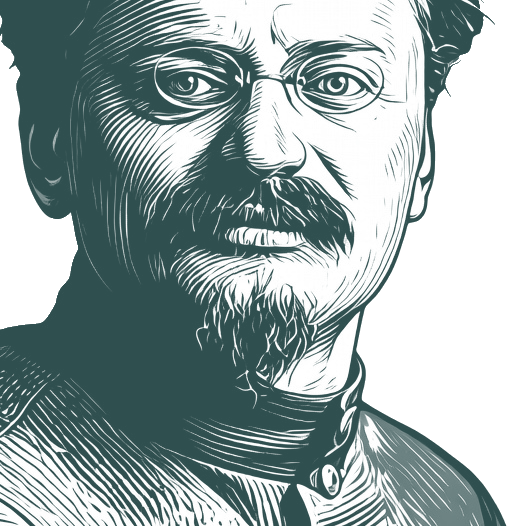
Leon Trotsky (Лев Давидович Троцкий; born Lev Davidovich Bronstein; Лев Давидович Бронштейн]; 7 November (O.S. 26 October) 1879 – 21 August 1940) was a Russian Marxist, intellectual, and revolutionary. In the early Soviet Union, he founded the Politburo, served as People's Commissar for Foreign Affairs, and created and led the Red Army. After Lenin's death, Trotsky was exiled for his opposition to Joseph Stalin's policies. His 1940 assassination (with an ice axe) in Mexico was carried out by a Soviet agent (Ramón Mercader) at Stalin's behest.
Bio from: Wikiquote (CC BY-SA 4.0) · Portrait adapted from: Wikimedia Commons (Public domain / CC0)
Pen Names:
Троцкий
•
Перо
•
Антид Ото
•
Л. Седов
•
Старик
Native Name:
Лейба Давидович Бронштейн
•
Лев Давидович Троцкий
Alternative Names:
Lev Bronstein
•
Lev Davidovich Bronshtein
•
Lev Davidovich Bronstein
•
Leon Trotski
•
Trotsky
•
Lev Davidovich Bronshteyn
•
Lev Bronshteyn
•
Lev Trotsky
•
Trotskiy
•
Lev Trotskiy
•
Lev Davidovich Trotsky
•
Lev Davidovich Trotskiy
From Wikidata (CC0)

Showing quotes in randomized order to avoid selection bias. Click Popular for most popular quotes.
Fascism has opened up the depths of society for politics...there lives alongside the 20th century the tenth and thirteenth...What inexhaustible reserves they possess of darkness, ignorance and savagery! Despair has raised them to their feet, fascism has given them a banner. Everything that should have been eliminated from the national organism in the form of cultural excrement in the course of normal development of society has now come gushing out from the throat; capitalist society is puking up the undigested barbarism. Such is the physiology of Nazism...
Try QuoteGPT
Chat naturally about what you need. Each answer links back to real quotes with citations.
This book was written in 1920 in the car of a military train and amid the flames of the civil war. The circumstance the reader must keep before his eyes if he wishes rightly to understand not only the basic material of the book, but also its harsh allusion, and particularly the tone in which it is written.
Italian fascism was the immediate outgrowth of the betrayal by the reformists of the uprising of the Italian proletariat. From the time the [first world] war ended, there was an upward trend in the revolutionary movement in Italy, and in September 1920 it resulted in the seizure of factories and industries by the workers. The dictatorship of the proletariat was an actual fact; all that was lacking was to organize it and draw from it all the necessary conclusions. The social democracy took fright and sprang back. After its bold and heroic exertions, the proletariat was left facing the void. The disruption of the revolutionary movement became the most important factor in the growth of fascism. In September, the revolutionary advance came to a standstill; and November already witnessed the first major demonstration of the fascists (the seizure of Bologna).
Unlimited Quote Collections
Organize your favorite quotes without limits. Create themed collections for every occasion with Premium.
It could and must, be explained that in the civil war we destroyed the White Guards in order that they should not destroy the workers. Consequently, our problem is not the destruction of human life, but its preservation. But as we have to struggle for the preservation of human life with arms in our hands, it leads to the destruction of human life - a puzzle the dialectical secret of which was explained by old Hegel, without reckoning other still more ancient sages.
During war all institutions and organs of the State and of public opinion become, directly or indirectly, weapons of warfare. This is particularly true of the Press. No government carrying on a serious war will allow publications to exist on its territory which, openly or indirectly support the enemy.
The German soldiers, that is, the workers and peasants, will in the majority of cases have far more sympathy for the vanquished peoples than for their own ruling caste. The necessity to act at every step in the capacity of 'pacifiers' and oppressors will swiftly disintegrate the armies of occupation, infecting them with a revolutionary spirit.
The serious and critical reader will not want a treacherous impartiality, which offers him a cup of conciliation with a well-settled poison of reactionary hate at the bottom, but a scientific conscientiousness, which for its sympathies and antipathies — open and undisguised — seeks support in an honest study of the facts, a determination of their real connections, an exposure of the causal laws of their movement.