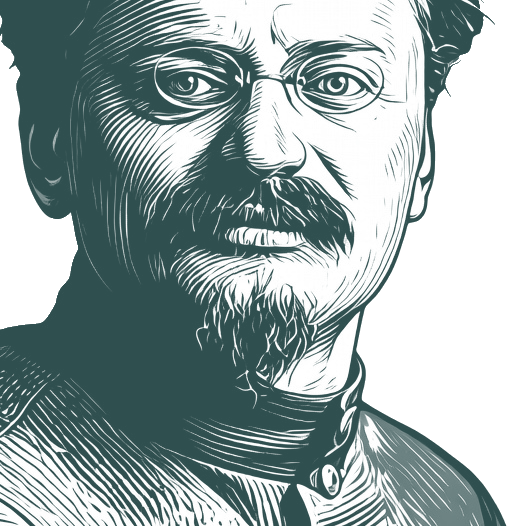
In a later work, Just and Unjust Wars: A Moral Argument with Historical Illustrations (2000) by Michael Walzer, the author states: War is most often … - Leon Trotsky
""
In a later work, Just and Unjust Wars: A Moral Argument with Historical Illustrations (2000) by Michael Walzer, the author states: War is most often a form of tyranny. It is best described by paraphrasing Trotsky's aphorism about the dialectic: "You may not be interested in war, but war is interested in you." This statement on dialectic itself seems to be a paraphrase, with the original in In Defense of Marxism Part VII : "Petty-Bourgeois Moralists and the Proletarian Party" (1942) — where Trotsky publishes a letter to Albert Goldman (5 June 1940) has been translated as "Burnham doesn't recognize dialectics but dialectics does not permit him to escape from its net." More discussion on the origins of this quotation can be found at The Semi-Daily Journal of Economist Brad DeLong: Fair and Balanced Almost Every Day.
English
Collect this quote
About
Leon Trotsky
Leon Trotsky (Лев Давидович Троцкий; born Lev Davidovich Bronstein; Лев Давидович Бронштейн]; 7 November (O.S. 26 October) 1879 – 21 August 1940) was a Russian Marxist, intellectual, and revolutionary. In the early Soviet Union, he founded the Politburo, served as People's Commissar for Foreign Affairs, and created and led the Red Army. After Lenin's death, Trotsky was exiled for his opposition to Joseph Stalin's policies. His 1940 assassination (with an ice axe) in Mexico was carried out by a Soviet agent (Ramón Mercader) at Stalin's behest.
Pen Names:
Троцкий
•
Перо
•
Антид Ото
•
Л. Седов
•
Старик
Native Name:
Лейба Давидович Бронштейн
•
Лев Давидович Троцкий
Alternative Names:
Lev Bronstein
•
Lev Davidovich Bronshtein
•
Lev Davidovich Bronstein
•
Leon Trotski
•
Trotsky
•
Lev Davidovich Bronshteyn
•
Lev Bronshteyn
•
Lev Trotsky
•
Trotskiy
•
Lev Trotskiy
•
Lev Davidovich Trotsky
•
Lev Davidovich Trotskiy
The completion of the socialist revolution within national limits is unthinkable.
The so-called “breeding” of the tsar, his ability to control himself in the most extraordinary circumstances, cannot be explained by a mere external training; its essence was an inner indifference, a poverty of spiritual forces, a weakness of the impulses of the will. That mask of indifference which was called breeding in certain circles, was a natural part of Nicholas at birth.
Works in ChatGPT, Claude, or Any AI
Add semantic quote search to your AI assistant via MCP. One command setup.
"With all due respect to all philistines, the dictatorship of the proletariat does just consist in "giving a hiding" to the classes that were previously supreme, before forcing them to recognize the new order and to submit to it."