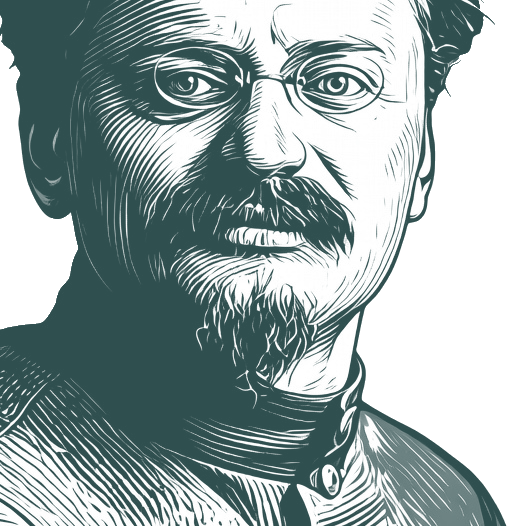
During war all institutions and organs of the State and of public opinion become, directly or indirectly, weapons of warfare. This is particularly tr… - Leon Trotsky
""
During war all institutions and organs of the State and of public opinion become, directly or indirectly, weapons of warfare. This is particularly true of the Press. No government carrying on a serious war will allow publications to exist on its territory which, openly or indirectly support the enemy.
Leon Trotsky (Лев Давидович Троцкий; born Lev Davidovich Bronstein; Лев Давидович Бронштейн]; 7 November (O.S. 26 October) 1879 – 21 August 1940) was a Russian Marxist, intellectual, and revolutionary. In the early Soviet Union, he founded the Politburo, served as People's Commissar for Foreign Affairs, and created and led the Red Army. After Lenin's death, Trotsky was exiled for his opposition to Joseph Stalin's policies. His 1940 assassination (with an ice axe) in Mexico was carried out by a Soviet agent (Ramón Mercader) at Stalin's behest.
Pen Names:
Троцкий
•
Перо
•
Антид Ото
•
Л. Седов
•
Старик
Native Name:
Лейба Давидович Бронштейн
•
Лев Давидович Троцкий
Alternative Names:
Lev Bronstein
•
Lev Davidovich Bronshtein
•
Lev Davidovich Bronstein
•
Leon Trotski
•
Trotsky
•
Lev Davidovich Bronshteyn
•
Lev Bronshteyn
•
Lev Trotsky
•
Trotskiy
•
Lev Trotskiy
•
Lev Davidovich Trotsky
•
Lev Davidovich Trotskiy
Let a man find himself, in distinction from others, on top of two wheels with a chain - at least in a poor country like Russia - and his vanity begins to swell out like his tires. In America it takes an automobile to produce this effect.
As long as human labor power, and, consequently, life itself, remain articles of sale and purchase, of exploitation and robbery, the principle of the “sacredness of human life” remains a shameful lie, uttered with the object of keeping the oppressed slaves in their chains.
PREMIUM FEATURE
Advanced Search Filters
Filter search results by source, date, and more with our premium search tools.
In Stalin each [Soviet bureaucrat] easily finds himself. But Stalin also finds in each one a small part of his own spirit. Stalin is the personification of the bureaucracy. That is the substance of his political personality.