There is a fatality, a feeling so irresistible and inevitable that it has the force of doom, which almost invariably compels human beings to linger around and haunt, ghostlike, the spot where some great and marked event has given the color to their lifetime; and still the more irresistibly, the darker the tinge that saddens it.
American author (1804–1864)
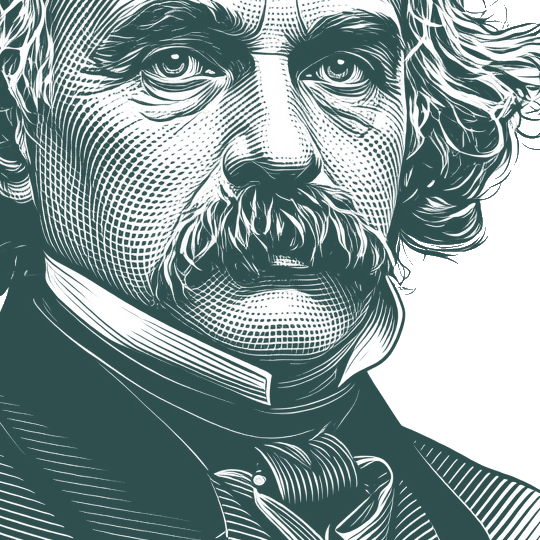
Nathaniel Hawthorne (4 July 1804 – 19 May 1864) was an American writer remembered for his romance novels (The Scarlet Letter, The House of the Seven Gables, The Blithedale Romance, and The Marble Faun) and short stories.
Bio from: Wikiquote (CC BY-SA 4.0) · Portrait adapted from: Wikimedia Commons, Mathew Benjamin Brady (Public domain / CC0)
Pen Names:
Monsieur de l’Aubépine
Birth Name:
Nathaniel Hathorne
Alternative Names:
Monsieur de l'Aubépine
•
N. H.
From Wikidata (CC0)

Showing quotes in randomized order to avoid selection bias. Click Popular for most popular quotes.
"But what could be the purpose of the unseasonable toil, which was again resumed, as the watchman knew by the lines of lamp-light through the crevices of Owen Warland's shutters? The townspeople had one comprehensive explanation of all these singularities. Owen Warland had gone mad! How universally efficacious — how satisfactory, too, and soothing to the injured sensibility of narrowness and dullness — is this easy method of accounting for whatever lies beyond the world's most ordinary scope!
- "The Artist of the Beautiful
There can be, if I forebode aright, no power, short of the Divine mercy, to disclose, whether by uttered words, or by type or emblem, the secrets that may be buried with a human heart. The heart, making itself guilty of such secrets, must perforce hold them, until the day when all hidden things shall be revealed. Nor have I so read or interpreted the Holy Writ, as to understand that the disclosure of human thoughts and deeds, then to be made, is intended as part of the retribution. That, surely, were a shallow view of it. No; these revelations, unless I greatly error, are meant merely to promote the intellectual satisfaction of all intelligent beings, who will stand waiting, on that day, to see the dark problem of this life made plain. A knowledge of men's hearts will be needful to the completest solution of that problem. And I conceive, moreover, that the hearts holding such secrets as you speak of will yield them up, at that last day, not with reluctance, but with a joy unutterable.
Every young sculptor seems to think that he must give the world some specimen of indecorous womanhood, and call it Eve, Venus, a Nymph, or any name that may apologize for a lack of decent clothing. I am weary, even more than I am ashamed, of seeing such things. Nowadays people are as good as born in their clothes, and there is practically not a nude human being in existence. An artist, therefore, as you must candidly confess, cannot sculpture nudity with a pure heart, if only because he is compelled to steal guilty glimpses at hired models. The marble inevitably loses its chastity under such circumstances. An old Greek sculptor, no doubt, found his models in the open sunshine, and among pure and princely maidens, and thus the nude statues of antiquity are as modest as violets, and sufficiently draped in their own beauty. But as for Mr. Gibson's colored Venuses (stained, I believe, with tobacco juice), and all other nudities of to-day, I really do not understand what they have to say to this generation, and would be glad to see as many heaps of quicklime in their stead.
Scattered... over the breasts of the surrounding mountains there were heaps of hoary mist, in fantastic shapes... or cloud, hovering in the gold radiance of the upper atmosphere. ...[I]t seemed almost as if mortal man might thus ascend into the heavenly regions. Earth was so mingled with sky... The great hills played a concert among themselves, each constituting a strain of airy sweetness.
[H]e was now a cold observer, looking on mankind as the subject of his experiment, and, at length, converting man and woman to be his puppets, and pulling the wires that moved them to such degrees of crime as were demanded by his study.
Thus Ethan Brand became a fiend. He began to be so from the moment that his moral nature had ceased to keep the pace of improvement with his intellect.
Finding it so directly on the threshold of our narrative, which is now about to issue from that inauspicious portal, we could hardly do otherwise than pluck one of its flowers and present it to the reader. It may serve, let us hope, to symbolize some sweet moral blossom, that may be found along the track, or relieve the darkening close of a tale of human frailty and sorrow.