American business consultant (1909–2005)
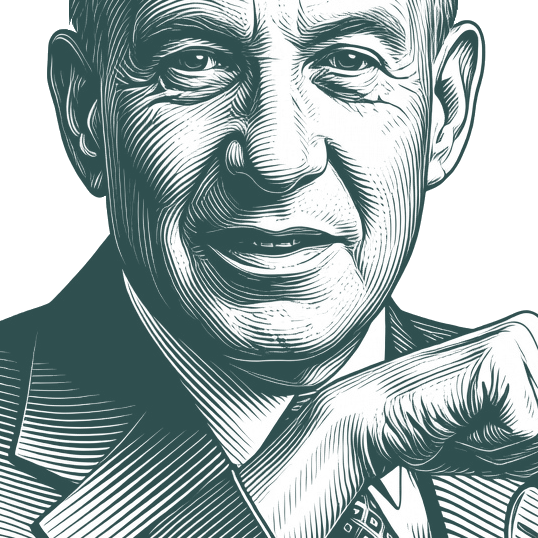
Peter Ferdinand Drucker (November 19 1909 – November 11 2005) was an Austrian-born American writer, management consultant and university professor. In 1943 he became a naturalized citizen of the United States. He taught at New York University and Claremont Graduate University respectively.
Bio from: Wikiquote (CC BY-SA 4.0) · Portrait adapted from: Wikimedia Commons, Jeff McNeill (CC BY-SA)
From Wikidata (CC0)
[W]e are all learning fast that we have to respect each other's basic beliefs and institutions, however much we must dislike them. If there is one lesson to this war, it is that the attempt to impose one's own system on the world, such as was made by both the Germans and the Japanese, must end not only in total world-wide conflict, but in the defeat and destruction of the country that makes the attempt.
DuPont, for 130 years, had confined itself to making munitions and explosives. In the mid-1920s it then organized its first research efforts in other areas, one of them the brand-new field of polymer chemistry, which the Germans had pioneered during World War I. For several years there were no results at all. Then, in 1928, an assistant left a burner on over the weekend. On Monday morning, Wallace H. Carothers, the chemist in charge, found that the stuff in the kettle had congealed into fibers. It took another ten years before DuPont found out how to make Nylon intentionally. The point of the story is, however, that the same accident had occurred several times in the laboratories of the big German chemical companies with the same results, and much earlier. The Germans were, of course, looking for a polymerized fiber — and they could have had it, along with world leadership in the chemical industry, ten years before DuPont had Nylon. But because they had not planned the experiment, they dismissed its results, poured out the accidentally produced fibers, and started all over again.
An organization is not, like an animal, an end in itself, and successful by the mere act of perpetuating the species. An organization is an organ of society and fulfills itself by the contribution it makes to the outside environment. And yet the bigger and apparently more successful an organization gets to be, the more will inside events tend to engage the interests, the energies, and the abilities of the executive to the exclusion of his real tasks and his real effectiveness in the outside.
What the worker needs is to see the plant as if he were a manager. Only thus can he see his part; from his part he cannot reach the whole. This "seeing" is not a matter of information, training courses, conducted plant tours, or similar devices. What is needed is the actual experience of the whole in and through the individual's work.
Equally striking is the fact that racial anti-Semitism was not taken seriously even by the great majority of Nazis. ‘It is just a catchword to attract voters’ was a standing phrase which everybody repeated and believed, and that I took it seriously was more than once regarded as definite proof of my stupidity and gullibility.
"Entrepreneurship rests on a theory of economy and society. The theory sees change as normal and indeed as healthy. And it sees the major task in society - and especially in the economy - as doing something different rather than doing better what is already being done. That is basically what Say, two hundred years ago, meant when he coined the term entrepreneur. It was intended as a manifesto and as a declaration of dissent: the entrepreneur upsets and disorganizes. As Joseph Schumpeter formulated it, his task is "creative destruction.
A person’s way of performing can be slightly modified, but it is unlikely to be completely changed — and certainly not easily. Just as people achieve results by doing what they are good at, they also achieve results by working in ways that they best perform. A few common personality traits usually determine how a person performs.
Limited Time Offer
Premium members can get their quote collection automatically imported into their Quotewise collections.
1. The first is simply not to try to be clever. Innovations have to be handled by ordinary human beings, if they are to attain any size and importance at all, by morons or near-morons. Incompetence, after all, is the only thing in abundant and never-failing supply. Anything too clever, whether in design or execution, is almost bound to fail.