It only takes one percent or less of The People... mobilized in every Congressional District... say three or four thousand [out of an average Congressional District population]... [A]s long as they represent a majority opinion... they can control the Congress against any vested interest. We used to do it on far less... regulating the auto industry, getting through the Freedom of Information Act, which was opposed by... almost every corporate trade association, because they didn't want government information on them available to the public.
American lawyer and activist (born 1934)
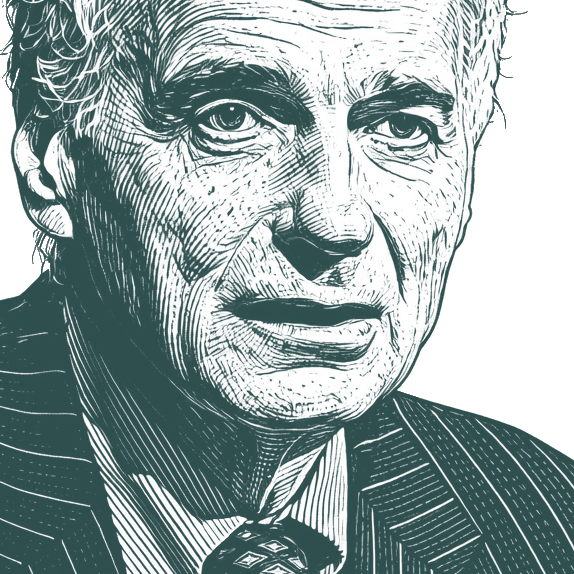
Ralph Nader (born 27 February 1934) is an American political activist, author, lecturer, and attorney, noted for his involvement in consumer protection, environmentalism and government reform causes.
Bio from: Wikiquote (CC BY-SA 4.0) · Portrait adapted from: Wikimedia Commons, https://www.flickr.com/photos/wickenden/ Don LaVange (CC BY-SA)
Alternative Names:
Nader
From Wikidata (CC0)
They say we have a free... independent judiciary, but... on the big questions of abuses of power, like going to war without congressional declaration... which is a requirement under out Constitution (and we have not had a declaration of war since 1941...) The courts have a very convenient doctrine. It's called, "This is a political question, invading Iraq, and we don't deal with political questions. This is to be decided between the Congress, which abdicates its duty, and the Presidency"... When citizens say "We don't believe in that. We're going to go to court," and go all the way to the Supreme Court to challenge this illegal war of criminal aggression against Iraq, they have another convenient doctrine... "You have no standing to sue." So all the American People have no standing to sue..? Well, who has a standing to sue... dealing with a criminal war of aggression... with all... who have died? Well, who has standing to sue? Only one person. The Attorney General, and guess who his boss is, the President.
Works in ChatGPT, Claude, or Any AI
Add semantic quote search to your AI assistant via MCP. One command setup.
Here we are in corporate occupied territory, otherwise known as Washington D.C. ...I've seen it ...become a very sophisticated expression of the plutocracy ...[Y]ou have the plutocracy ruled by a few wealthy, developing an ever more penetrating oligarchy ruled by a few politicos, indentured to the super-wealthy. ...With their corporate attorneys they have developed one of the most sophisticated controls of a formerly democratic society... turning the very institutions, Congress, the courts, the executive branch, against the people... What they do is simply keep the myths alive, like "We have Democratic elections." We do not.
Exxon/Mobile, Pfizer, Citigroup, General Motors, Lockheed/Martin, Proctor & Gamble, United Health Care, Comcast/NBC Universal, Apple, and many other giants garner revenues as large as numerous nation states... Most are global... but there is no public global government holding them accountable... [T]here are dictatorial trade agreements that corporatists conjure up to subordinate the general population's labor, consumer, and environmental protections—a stunning end-run around our courts and legislatures. These protections are seen as "non-tariff trade barriers"... [T]hese... entities have a clear and obsessive unity of purpose—money for bosses... for shareholders, money to buy lawyers and politicians to take down laws and whatever else slows the pace of hoarding wealth.
America's business leaders said NO to the idea of revolting against the British monarchy. ...In later decades, commercialists... consistently said NO to efforts to end child labor... to starting labor unions... to the regulation of railroad and banking abuses... to the 40-hour work week and progressive taxation... to antitrust laws and the regulatory agencies... to a woman's right to vote (they feared the women's vote against exploiting child labor and cheating consumers), and NO to the minimum wage, Social Security, universal healthcare, and to... protect the environment, empower consumers, reduce government secrecy, protect ethical whistleblowers, and... to reduce commercial fraud on the government as with Medicare and military contracts.
Before and after the American Revolution, there has been a continuing daily tension between contending private commercial pursuits and common civic values. ...[T]he obsessive drive for gold, money, and profit is a formidable deviation from other more important spiritual practices that strive to center community on non-market values... love, generosity, kindness, cooperation, and non-violence.
America's Founding Fathers wrote a Constitution that never once uses the words "corporation," "company," or "political parties." Their use of language reflected their antipathy toward the domineering influence of empire and big business... If "We the People" are the sole subjects of the Constitution, why is it that we are ruled by large corporations and their largely indentured servants—the Republican and Democratic Parties... "We the People" have allowed these plutocratic forces to slowly siphon away our power.
In addition to stimulating the economy, creating more jobs, and establishing less need for public welfare assistance, the movement for a... living wage... teaches how little it... takes to change the balance of power... especially when there is overwhelming public opinion... These lessons... should be, applied to winning the myriad of public interest, ecological, and civil rights struggles that the ultra-rich and their commercial interests obstruct... increasing wages... decreasing militarism and crushing... military spending... decent and affordable housing and healthcare, reducing... carbon emissions... to prevent catastrophic climate change... enabling democracy at all levels.