If you want to expel religion from our European civilization, you can only do it by means of another system of doctrines; and such a system would from the outset take over all the psychological characteristics of religion — the same sanctity, rigidity and intolerance, the same prohibition of thought — for its own defence. You have to have something of the kind in order to meet the requirements of education. And you cannot do without education.
Austrian psychiatrist and founder of psychoanalysis (1856–1939)
Sigmund Freud ([ˈziːgmʊnt ˈfrɔʏ̯t]; 6 May 1856 – 23 September 1939) was an Austrian neurologist and psychiatrist and the founder of the psychoanalytic school of psychology. He was the father of Anna Freud, the grandfather of Sir Clement Freud and Lucian Freud, and the uncle of Edward Bernays.
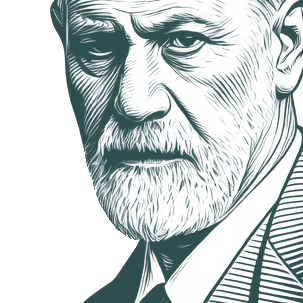
Bio from: Wikiquote (CC BY-SA 4.0) · Portrait adapted from: Wikimedia Commons, Max Halberstadt (Public domain / CC0)
Alternative Names:
Sigismund Schlomo Freud
•
Sigmund Schlomo Freud
•
Sigismund Freud
•
Freud
From Wikidata (CC0)

Showing quotes in randomized order to avoid selection bias. Click Popular for most popular quotes.
Enhance Your Quote Experience
Enjoy ad-free browsing, unlimited collections, and advanced search features with Premium.
No other technique for the conduct of life attaches the individual so firmly to reality as laying emphasis on work; for his work at least gives him a secure place in a portion of reality, in the human community. The possibility it offers of displacing a large amount of libidinal components, whether narcissistic, aggressive or even erotic, on to professional work and on to the human relations connected with it lends it a value by no means second to what it enjoys as something indispensible to the preservation and justification of existence in society. Professional activity is a source of special satisfaction if it is a freely chosen one — if, that is to say, by means of sublimation, it makes possible the use of existing inclinations, of persisting or constitutionally reinforced instinctual impulses. And yet, as a path to happiness, work is not highly prized by men. They do not strive after it as they do after other possibilities of satisfaction. The great majority of people only work under the stress of necessity, and this natural human aversion to work raises most difficult social problems.
One might compare the relation of the ego to the id with that between a rider and his horse. The horse provides the locomotor energy, and the rider has the prerogative of determining the goal and of guiding the movements of his powerful mount towards it. But all too often in the relations between the ego and the id we find a picture of the less ideal situation in which the rider is obliged to guide his horse in the direction in which it itself wants to go.
Suffering comes from three quarters: from our own body, which is destined to decay and dissolution, and cannot even dispense with anxiety and pain as danger-signals; from the outer world, which can rage against us with the most powerful and pitiless forces of destruction; and finally from our relations with other men.