If the young aspirant is not rich enough for Parliament, and is deterred by the basilisks or otherwise from entering on Law or Church, and cannot altogether reduce his human intellect to the beaverish condition, or satisfy himself with the prospect of making money,—what becomes of him in such case, which is naturally the case of very many, and ever of more? In such case there remains but one outlet for him, and notably enough that too is a talking one: the outlet of Literature, of trying to write Books. Since, owing to preliminary basilisks, want of cash, or superiority to cash, he cannot mount aloft by eloquent talking, let him try it by dexterous eloquent writing. Here happily, having three fingers, and capital to buy a quire of paper, he can try it to all lengths and in spite of all mortals: in this career there is happily no public impediment that can turn him back; nothing but private starvation—which is itself a finis or kind of goal—can pretend to hinder a British man from prosecuting Literature to the very utmost, and wringing the final secret from her: "A talent is in thee; No talent is in thee." To the British subject who fancies genius may be lodged in him, this liberty remains; and truly it is, if well computed, almost the only one he has.
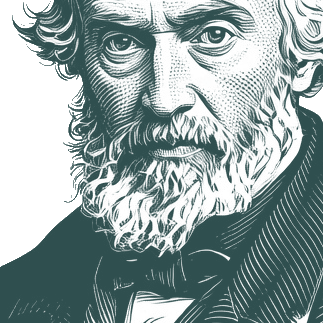
Scottish essayist, historian and philosopher (1795–1881)
Thomas Carlyle (December 4 1795 – February 5 1881) was a Scottish essayist, historian and philosopher of great prominence during the Victorian era. His wife was Jane Welsh Carlyle.
Bio from: Wikiquote (CC BY-SA 4.0) · Portrait adapted from: Wikimedia Commons, Sir John Everett Millais, 1st Bt (died 1896) (Public domain / CC0)
Alternative Names:
The Sage of Chelsea
From Wikidata (CC0)

Showing quotes in randomized order to avoid selection bias. Click Popular for most popular quotes.
Clearness, emphatic clearness, was his highest category of man's thinking power. He delighted always to hear good argument. He would often say, I would like to hear thee argue with him." He said this of Jeffrey and me, with an air of such simple earnestness, not two years ago (1830), and it was his true feeling. I have often pleased him much by arguing with men (as many years ago I was prone to do) in his presence. He rejoiced greatly in my success, at all events in my dexterity and manifested force. Others of us he admired for our "activity," our practical valor and skill, all of us (generally speaking) for our decent demeanor in the world. It is now one of my greatest blessings (for which I would thank Heaven from the heart) that he lived to see me, through various obstructions, attain some look of doing well. He had "educated" me against much advice, I believe, and chiefly, if not solely, from his own noble faith. James Bell, one of our wise men, had told him, "Educate a boy, and he grows up to despise his ignorant parents." My father once told me this, and added, "Thou hast not done so; God be thanked for it." I have reason to think my father was proud of me (not vain, for he never, except when provoked, openly bragged of us); that here too he lived to see the pleasure of the Lord prosper in his hands. Oh, was it not a happiness for me! The fame of all this planet were not henceforth so precious.
Works in ChatGPT, Claude, or Any AI
Add semantic quote search to your AI assistant via MCP. One command setup.
This Burns appeared under every disadvantage: uninstructed, poor, born only to hard manual toil; and writing, when it came to that, in a rustic special dialect, known only to a small province of the country he lived in. Had he written, even what he did write, in the general language of England, I doubt not he had already become universally recognized as being, or capable to be, one of our greatest men.
That, on the whole, if you have got the intrinsic qualities, you have got everything, and the preliminaries will prove attainable; but that if you have got only the preliminaries, you have yet got nothing. A man of real dignity will not find it impossible to bear himself in a dignified manner; a man of real understanding and insight will get to know, as the fruit of his very first study, what the laws of his situation are, and will conform to these.
With respect to Duels, indeed, I have my own ideas. Few things, in this so surprising world, strike me with more surprise. Two little visual Spectra of men, hovering with insecure enough cohesion in the midst of the UNFATHOMABLE, and to dissolve therein, at any rate, very soon, — make pause at the distance of twelve paces asunder; whirl round; and, simultaneously by the cunningest mechanism, explode one another into Dissolution; and off-hand become Air, and Non-extant! Deuce on it (verdammt), the little spitfires! — Nay, I think with old Hugo von Trimberg: 'God must needs laugh outright, could such a thing be, to see his wondrous Manikins here below.
Much has been said of Mahomet's propagating his Religion by the sword. It is no doubt far nobler what we have to boast of the Christian Religion, that it propagated itself peaceably in the way of preaching and conviction. Yet withal, if we take this for an argument of the truth or falsehood of a religion, there is a radical mistake in it. The sword indeed: but where will you get your sword! Every new opinion, at its starting, is precisely in a minority of one. In one man's head alone, there it dwells as yet. One man alone of the whole world believes it; there is one man against all men. That he take a sword, and try to propagate with that, will do little for him. You must first get your sword! On the whole, a thing will propagate itself as it can. We do not find, of the Christian Religion either, that it always disdained the sword, when once it had got one.
It is truly a lordly spectacle how this great soul takes in all kinds of men and objects, a Falstaff, an Othello, a Juliet, a Coriolanus; sets them all forth to us in their round completeness; loving, just, the equal brother of all. Novum Organum, and all the intellect you will find in Bacon, is of a quite secondary order; earthy, material, poor in comparison with this. Among modern men, one finds, in strictness, almost nothing of the same rank. Goethe alone, since the days of Shakspeare, reminds me of it. Of him too you say that he saw the object; you may say what he himself says of Shakspeare: 'His characters are like watches with dial-plates of transparent crystal; they show you the hour like others, and the inward mechanism also is all visible.'.