Scottish essayist, historian and philosopher (1795–1881)
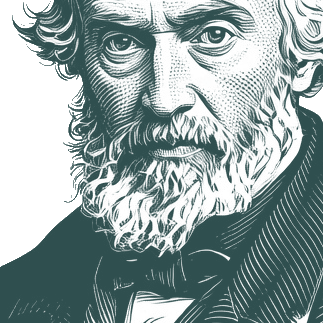
Thomas Carlyle (December 4 1795 – February 5 1881) was a Scottish essayist, historian and philosopher of great prominence during the Victorian era. His wife was Jane Welsh Carlyle.
Bio from: Wikiquote (CC BY-SA 4.0) · Portrait adapted from: Wikimedia Commons, Sir John Everett Millais, 1st Bt (died 1896) (Public domain / CC0)
From Wikidata (CC0)

Strange enough how creatures of the human-kind shut their eyes to plainest facts; and by the mere inertia of Oblivion and Stupidity, live at ease in the midst of Wonders and Terrors. But indeed man is, and was always, a blockhead and dullard; much readier to feel and digest, than to think and consider.
For, in fact, I say the degree of vision that dwells in a man is a correct measure of the man. If called to define Shakspeare's faculty, I should say superiority of Intellect, and think I had included all under that. What indeed are faculties? We talk of faculties as if they were distinct, things separable; as if a man had intellect, imagination, fancy, &c., as he has hands, feet and arms. That is a capital error. Then again, we hear of a man's "intellectual nature," and of his "moral nature," as if these again were divisible, and existed apart. Necessities of language do perhaps prescribe such forms of utterance; we must speak, I am aware, in that way, if we are to speak at all. But words ought not to harden into things for us. It seems to me, our apprehension of this matter is, for most part, radically falsified thereby. We ought to know withal, and to keep forever in mind, that these divisions are at bottom but names; that man's spiritual nature, the vital Force which dwells in him, is essentially one and indivisible; that what we call imagination, fancy, understanding, and so forth, are but different figures of the same Power of Insight, all indissolubly connected with each other, physiognomically related; that if we knew one of them, we might know all of them. Morality itself, what we call the moral quality of a man, what is this but another side of the one vital Force whereby he is and works? All that a man does is physiognomical of him. You may see how a man would fight, by the way in which he sings; his courage, or want of courage, is visible in the word he utters, in the opinion he has formed, no less than in the stroke he strikes. He is one; and preaches the same Self abroad in all these ways.
To reconcile Despotism with Freedom:—well, is that such a mystery? Do you not already know the way? It is to make your Despotism just. Rigorous as Destiny; but just too, as Destiny and its Laws. The Laws of God: all men obey these, and have no 'Freedom' at all but in obeying them. The way is already known, part of the way;—and courage and some qualities are needed for walking on it!
I here, on the very threshold, protest against it in reference to Paganism, and to all other isms by which man has ever for a length of time striven to walk in this world. They have all had a truth in them, or men would not have taken them up. Quackery and dupery do abound; in religions, above all in the more advanced decaying stages of religions, they have fearfully abounded: but quackery was never the originating influence in such things; it was not the health and life of such things, but their disease, the sure precursor of their being about to die! Let us never forget this.
In the lowest broad strata of the population, equally as in the highest and narrowest, are produced men of every kind of genius; man for man, your chance of genius is as good among the millions as among the units;—and class for class, what must it be! From all classes, not from certain hundreds now but from several millions, whatsoever man the gods had gifted with intellect and nobleness, and power to help his country, could be chosen: O Heavens, could,—if not by Tenpound Constituencies and the force of beer, then by a Reforming Premier with eyes in his head, who I think might do it quite infinitely better. Infinitely better. For ignobleness cannot, by the nature of it, choose the noble: no, there needs a seeing man who is himself noble, cognizant by internal experience of the symptoms of nobleness.
Thus Mr. Sale informs me, the old Arab Tribes would gather in liveliest gaudeamus, and sing, and kindle bonfires, and wreathe crowns of honour, and solemnly thank the gods that, in their Tribe too, a Poet had shewn himself. As indeed they well might; for what usefuller, I say not nobler and heavenlier thing could the gods, doing their very kindest, send to any Tribe or Nation, in any time or circumstances?