Paganism we recognized as a veracious expression of the earnest awe-struck feeling of man towards the Universe; veracious, true once, and still not without worth for us. But mark here the difference of Paganism and Christianism; one great difference. Paganism emblemed chiefly the Operations of Nature; the destinies, efforts, combinations, vicissitudes of things and men in this world; Christianism emblemed the Law of Human Duty, the Moral Law of Man. One was for the sensuous nature: a rude helpless utterance of the first Thought of men,—the chief recognized virtue, Courage, Superiority to Fear. The other was not for the sensuous nature, but for the moral. What a progress is here, if in that one respect only—!
Scottish essayist, historian and philosopher (1795–1881)
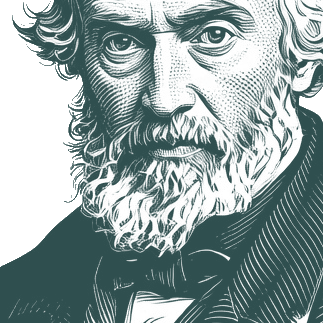
Thomas Carlyle (December 4 1795 – February 5 1881) was a Scottish essayist, historian and philosopher of great prominence during the Victorian era. His wife was Jane Welsh Carlyle.
Bio from: Wikiquote (CC BY-SA 4.0) · Portrait adapted from: Wikimedia Commons, Sir John Everett Millais, 1st Bt (died 1896) (Public domain / CC0)
Alternative Names:
The Sage of Chelsea
From Wikidata (CC0)

Showing quotes in randomized order to avoid selection bias. Click Popular for most popular quotes.
In that strange island Iceland,—burst up, the geologists say, by fire from the bottom of the sea; a wild land of barrenness and lava; swallowed many months of every year in black tempests, yet with a wild gleaming beauty in summertime; towering up there, stern and grim, in the North Ocean with its snow jokuls, roaring geysers, sulphur-pools and horrid volcanic chasms, like the waste chaotic battle-field of Frost and Fire;—where of all places we least looked for Literature or written memorials, the record of these things was written down.
For what imaginable purpose was man made, if not to be "happy"? By victorious Analysis, and Progress of the Species, happiness enough now awaits him. Kings can become philosophers; or else philosophers Kings. Let but Society be once rightly constituted,—by victorious Analysis. The stomach that is empty shall be filled; the throat that is dry shall be wetted with wine. Labour itself shall be all one as rest; not grievous, but joyous Wheat-fields, one would think, cannot come to grow untilled; no man made clayey, or made weary thereby;—unless indeed machinery will do it? Gratuitous Tailors and Restaurateurs may start up, at fit intervals, one as yet sees not how. But if each will, according to rule of Benevolence, have a care for all, then surely—no one will be uncared for. Nay, who knows but by sufficiently victorious Analysis, "human life may be indefinitely lengthened," and men get rid of Death, as they have already done of the Devil? We shall then be happy in spite of Death and the Devil.
The seeing eye! It is this that discloses the inner harmony of things; what Nature meant, what musical idea Nature has wrapped up in these often rough embodiments. Something she did mean. To the seeing eye that something were discernible. Are they base, miserable things? You can laugh over them, you can weep over them; you can in some way or other genially relate yourself to them; — you can, at lowest, hold your peace about them, turn away your own and others' face from them, till the hour come for practically exterminating and extinguishing them!
Works in ChatGPT, Claude, or Any AI
Add semantic quote search to your AI assistant via MCP. One command setup.
Thou, O World, how wilt thou secure thyself against this man? Thou canst not hire him by thy guineas; nor by thy gibbets and law-penalties restrain him. He eludes thee like a Spirit. Thou canst not forward him, thou canst not hinder him. Thy penalties, thy poverties, neglects, contumelies: behold, all these are good for him. Come to him as an enemy; turn from him as an unfriend; only do not this one thing,—infect him not with thy own delusion: the benign Genius, were it by very death, shall guard him against this!—What wilt thou do with him? He is above thee, like a god. Thou, in thy stupendous three-inch pattens, art under him. He is thy born king, thy conqueror and supreme lawgiver: not all the guineas and cannons, and leather and prunella, under the sky can save thee from him. Hardest thickskinned Mammon-world, ruggedest Caliban shall obey him, or become not Caliban but a cramp. Oh, if in this man, whose eyes can flash Heaven's lightning, and make all Calibans into a cramp, there dwelt not, as the essence of his very being, a God's justice, human Nobleness, Veracity and Mercy,—I should tremble for the world. But his strength, let us rejoice to understand, is even this: The quantity of Justice, of Valour and Pity that is in him. To hypocrites and tailored quacks in high places, his eyes are lightning; but they melt in dewy pity softer than a mother's to the downpressed, maltreated; in his heart, in his great thought, is a sanctuary for all the wretched.
Men do reverence men. Men do worship in that 'one temple of the world,' as Novalis calls it, the Presence of a Man! Hero-worship, true and blessed, or else mistaken, false and accursed, goes on everywhere and everywhen. In this world there is one godlike thing, the essence of all that was or ever will be of godlike in this world: the veneration done to Human Worth by the hearts of men. Hero-worship, in the souls of the heroic, of the clear and wise,—it is the perpetual presence of Heaven in our poor Earth: when it is not there, Heaven is veiled from us; and all is under Heaven's ban and interdict, and there is no worship, or worthship, or worth or blessedness in the Earth any more!—
Today
So here hath been dawning
Another blue Day:
Think wilt thou let it
Slip useless away.
Out of Eternity
This new Day is born;
Into Eternity,
At night, will return.
Behold it aforetime
No eye ever did:
So soon it forever
From all eyes is hid.
Here hath been dawning
Another blue Day:
Think wilt thou let it
Slip useless away.
Paris, which for sixty years past has been the City of Insurrections. The French People had plumed themselves on being, whatever else they were not, at least the chosen "soldiers of liberty," who took the lead of all creatures in that pursuit, at least; and had become, as their orators, editors and litterateurs diligently taught them, a People whose bayonets were sacred, a kind of Messiah People, saving a blind world in its own despite, and earning for themselves a terrestrial and even celestial glory very considerable indeed.
Unlimited Quote Collections
Organize your favorite quotes without limits. Create themed collections for every occasion with Premium.