Scottish essayist, historian and philosopher (1795–1881)
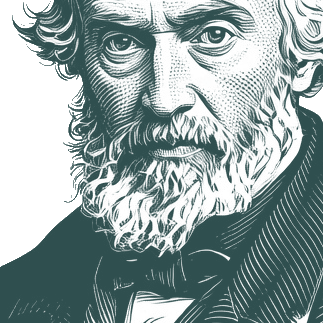
Thomas Carlyle (December 4 1795 – February 5 1881) was a Scottish essayist, historian and philosopher of great prominence during the Victorian era. His wife was Jane Welsh Carlyle.
Bio from: Wikiquote (CC BY-SA 4.0) · Portrait adapted from: Wikimedia Commons, Sir John Everett Millais, 1st Bt (died 1896) (Public domain / CC0)
From Wikidata (CC0)

Innumerable men had passed by, across this Universe, with a dumb vague wonder, such as the very animals may feel; or with a painful, fruitlessly inquiring wonder, such as men only feel;—till the great Thinker came, the original man, the Seer; whose shaped spoken Thought awakes the slumbering capability of all into Thought. It is ever the way with the Thinker, the spiritual Hero. What he says, all men were not far from saying, were longing to say. The Thoughts of all start up, as from painful enchanted sleep, round his Thought; answering to it, Yes, even so! Joyful to men as the dawning of day from night;—is it not, indeed, the awakening for them from no-being into being, from death into life? We still honor such a man; call him Poet, Genius, and so forth: but to these wild men he was a very magician, a worker of miraculous unexpected blessing for them; a Prophet, a God!
Religion was the pole-star for my father. Rude and uncultivated as he otherwise was, it made him and kept him "in all points a man." Oh! when I think that all the area in boundless space he had seen was limited to a circle of some fifty miles' diameter (he never in his life was farther or elsewhere so far from home as at Craigenputtoch), and all his knowledge of the boundless time was derived from his Bible and what the oral memories of old men could give him, and his own could gather; and yet, that he was such, I could take shame to myself. I feel to my father — so great though so neglected, so generous also towards me — a strange tenderness, and mingled pity and reverence peculiar to the case, infinitely soft and near my heart. Was he not a sacrifice to me? Had I stood in his place, could he not have stood in mine, and more? Thou good father! well may I forever honor thy memory. Surely that act was not without its reward. And was not nature great, out of such materials to make such a man?
Thou, O World, how wilt thou secure thyself against this man? Thou canst not hire him by thy guineas; nor by thy gibbets and law-penalties restrain him. He eludes thee like a Spirit. Thou canst not forward him, thou canst not hinder him. Thy penalties, thy poverties, neglects, contumelies: behold, all these are good for him. Come to him as an enemy; turn from him as an unfriend; only do not this one thing,—infect him not with thy own delusion: the benign Genius, were it by very death, shall guard him against this!—What wilt thou do with him? He is above thee, like a god. Thou, in thy stupendous three-inch pattens, art under him. He is thy born king, thy conqueror and supreme lawgiver: not all the guineas and cannons, and leather and prunella, under the sky can save thee from him. Hardest thickskinned Mammon-world, ruggedest Caliban shall obey him, or become not Caliban but a cramp. Oh, if in this man, whose eyes can flash Heaven's lightning, and make all Calibans into a cramp, there dwelt not, as the essence of his very being, a God's justice, human Nobleness, Veracity and Mercy,—I should tremble for the world. But his strength, let us rejoice to understand, is even this: The quantity of Justice, of Valour and Pity that is in him. To hypocrites and tailored quacks in high places, his eyes are lightning; but they melt in dewy pity softer than a mother's to the downpressed, maltreated; in his heart, in his great thought, is a sanctuary for all the wretched.