English novelist and poet (1840–1928)
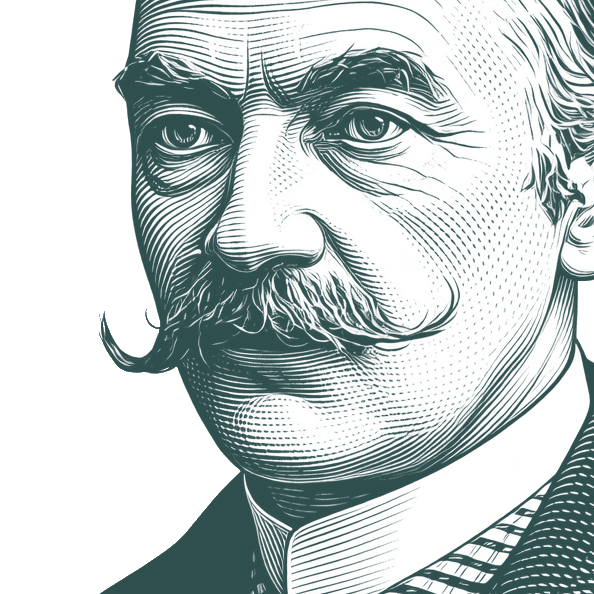
Thomas Hardy OM (June 2 1840 – January 11 1928) was an English novelist, short story writer and poet.
Bio from: Wikiquote (CC BY-SA 4.0) · Portrait adapted from: Wikimedia Commons, Bain News Service, publisher (Public domain / CC0)

Showing quotes in randomized order to avoid selection bias. Click Popular for most popular quotes.
He grew away from old associations, and saw something new in life and humanity. Secondarily, he made close acquaintance with phenomena which he had before known but darkly - the seasons in their moods, morning and evening, night and noon, winds in their different tempers, trees, waters and mists, shades and silences, and the voices of inanimate things.
They spoke very little of their mutual feeling; pretty phrases and warm expressions being probably unnecessary between such tried friends. Theirs was that substantial affection which arises (if any arises at all) when the two who are thrown together begin first by knowing the rougher sides of each other's character, and not the best till further on, the romance growing up in the interstices of a mass of hard prosaic reality. This good-fellowship — camaraderie — usually occurring through similarity of pursuits, is unfortunately seldom superadded to love between the sexes, because men and women associate, not in their labours, but in their pleasures merely. Where, however, happy circumstance permits its development, the compounded feeling proves itself to be the only love which is strong as death — that love which many waters cannot quench, nor the floods drown, beside which the passion usually called by the name is evanescent as steam.
I have no fear of men, as such, nor of their books. I have mixed with them — one or two of them particularly — almost as one of their own sex. I mean I have not felt about them as most women are taught to feel — to be on their guard against attacks on their virtue; for no average man — no man short of a sensual savage — will molest a woman by day or night, at home or abroad, unless she invites him. Until she says by a look 'Come on' he is always afraid to, and if you never say it, or look it, he never comes.
Suddenly an unexpected series of sounds began to be heard in this place up against the starry sky. They were the notes of Oak´s flute. It came from the direction of a small dark object under the hedge - a shephard´s hut - now presenting an outline to which an unintiated person might have been puzzled to attach either meaning or use. ... Being a man not without a frequent consciousness that there was some charm in this life he led, he stood still after looking at the sky as a useful instrument, and regarded it in an appreciative spirit, as a work of art superlatively beautiful. For a moment he seemed impressed with the speaking loneliness of the scene, or rather with the complete abstraction from all its compass of the sights and sounds of man. ... Oak´s motions, though they had a quiet energy, were slow, and their deliberateness accorded well with his occupation. Fitness being the basis of beauty, nobody could have denied tha his steady swings and turns in and about the flock had elements of grace. His special power, morally, physically, and mentally, was static. ... Oak was an intensely human man: indee, his humanity tore in pieces any politic intentions of his which bordered on strategy, and carried him on as by gravitation. A shadow in his life had always been that his flock should end in mutton - that a day could find a shepherd an arrant traitor to his gentle sheep.
PREMIUM FEATURE
Advanced Search Filters
Filter search results by source, date, and more with our premium search tools.