American poet, essayist and journalist (1819–1892)
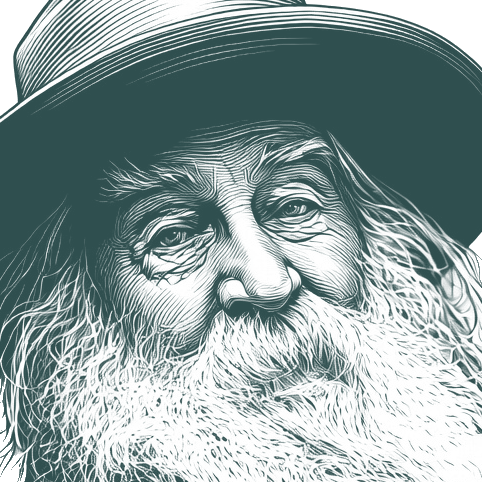
Walt Whitman (May 31, 1819 – March 26, 1892) was an American journalist and poet, most famous for his lifelong work on his book Leaves of Grass.
Bio from: Wikiquote (CC BY-SA 4.0) · Portrait adapted from: Wikimedia Commons, George Collins Cox / Adam Cuerden (Public domain / CC0)
From Wikidata (CC0)

O Me! O life!... of the questions of these recurring;
Of the endless trains of the faithless — of cities fill’d with the foolish;
Of myself forever reproaching myself, (for who more foolish than I, and who more faithless?)
Of eyes that vainly crave the light — of the objects mean — of the struggle ever renew’d;
Of the poor results of all — of the plodding and sordid crowds I see around me;
Of the empty and useless years of the rest — with the rest me intertwined;
The question, O me! so sad, recurring — What good amid these, O me, O life?
Answer.
That you are here — that life exists, and identity;
That the powerful play goes on, and you will contribute a verse.
We Americans have yet to really learn our own antecedents, and sort them, to unify them. They will be found ampler than has been supposed, and in widely different sources. Thus far, impress'd by New England writers and schoolmasters, we tacitly abandon ourselves to the notion that our United States has been fashion'd from the British Islands only, and essentially form a second England only — which is a very great mistake.
When I heard the learn’d astronomer;
When the proofs, the figures, were ranged in columns before me;
When I was shown the charts and the diagrams, to add, divide, and measure them;
When I, sitting, heard the astronomer, where he lectured with much applause in the
lecture-room,
How soon, unaccountable, I became tired and sick;
Till rising and gliding out, I wander’d off by myself,
In the mystical moist night-air, and from time to time,
Look’d up in perfect silence at the stars.
O Banner!
Not houses of peace are you, nor any nor all of their prosperity; if need be you shall have every one of those houses to destroy them;
You thought not to destroy those valuable houses, standing fast, full of comfort, built with money;
May they stand fast then? Not an hour, unless you, above them and all, stand fast.
But I am not the sea nor the red sun,
I am not the wind with girlish laughter,
Not the immense wind which strengthens, not the wind which lashes,
Not the spirit that ever lashes its own body to terror and death,
But I am that which unseen comes and sings, sings, sings,
Which babbles in brooks and scoots in showers on the land,
Which the birds know in the woods mornings and evenings,
And the shore-sands know and the hissing wave, and that banner and pennant,
Aloft there flapping and flapping.
I have said that the soul is not more than the body,
And I have said that the body is not more than the soul,
And nothing, not God, is greater to one than one's self is,
And whoever walks a furlong without sympathy walks to his own
funeral drest in his shroud,
And I or you pocketless of a dime may purchase the pick of the
earth,
And to glance with an eye or show a bean in its pod confounds the
learning of all times,
And there is no trade or employment but the young man following it
may become a hero,
And there is no object so soft but it makes a hub for the wheel'd
universe,
And I say to any man or woman, Let your soul stand cool and composed
before a million universes.
And I say to mankind, Be not curious about God,
For I who am curious about each am not curious about God,
(No array of terms can say how much I am at peace about God and
about death.)
I hear and behold God in every object, yet understand God not in the
least,
Nor do I understand who there can be more wonderful than myself.
Why should I wish to see God better than this day?
I see something of God each hour of the twenty-four, and each moment
then,
In the faces of men and women I see God, and in my own face in the
glass,
I find letters from God dropt in the street, and every one is sign'd
by God's name,
And I leave them where they are, for I know that wheresoe'er I go,
Others will punctually come for ever and ever.