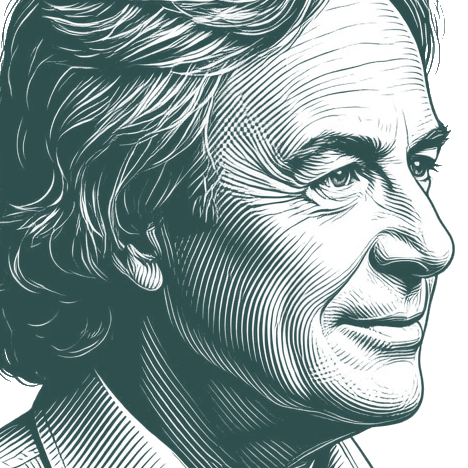
Richard Phillips Feynman (May 11, 1918 – February 15, 1988) was an American theoretical physicist. He is known for the work he did in the path integral formulation of quantum mechanics, the theory of quantum electrodynamics, the physics of the superfluidity of supercooled liquid helium, and in particle physics, for which he proposed the parton model. For his contributions to the development of quantum electrodynamics, Feynman received the Nobel Prize in Physics in 1965 jointly with Julian Schwinger and Shin'ichirō Tomonaga. Feynman developed a widely used pictorial representation scheme for the mathematical expressions describing the behavior of subatomic particles, which later became known as Feynman diagrams. During his lifetime, Feynman became one of the best-known scientists in the world.
Biography information from
Wikiquote·
Portrait adapted from
Wikimedia Commons, Copyright Tamiko Thiel 1984 (CC BY-SA)
Also Known As
Pen Names:
Ofey
Native Name:
Richard Phillips Feynman
Alternative Names:
Feynman
•
Dick Feynman
•
Richard P. Feynman
I start with the simplest phenomena... the first... is the phenomena of light. Early on, when light was being investigated by Newton, he thought that the light that came into the eye was like a rain of particles, like rain drops... [M]ore light meant more particles... and one kind of color light would one kind of rain drop and another... would be a different kind of rain drop... over the whole spectrum... and if we would some day have sufficiently delicate instruments, we would presumably discover that it was like a pattering... [I]t would go click, click, click when the particles came raining down. ...He also discovered ...the light from the soap bubbles or light from thin films... The brightness of reflection... depends on how thick the film is. As the film gets thicker and thinner, it gets brighter and darker. That was hard for him to understand from the point of view of particles. Finally a theory of waves was invented which explained that very easily... until we measured light very precisely... and lo and behold, to our horror, it behaved like particles.
I really can't do a good job, any job, of explaining magnetic force in terms of something you're more familiar with, because I do not understand it in terms of something you are more familiar with.
PREMIUM FEATURE
Advanced Search Filters
Filter search results by source, date, and more with our premium search tools.