American theoretical physicist (1918–1988)
Richard Phillips Feynman (May 11, 1918 – February 15, 1988) was an American theoretical physicist. He is known for the work he did in the path integral formulation of quantum mechanics, the theory of quantum electrodynamics, the physics of the superfluidity of supercooled liquid helium, and in particle physics, for which he proposed the parton model. For his contributions to the development of quantum electrodynamics, Feynman received the Nobel Prize in Physics in 1965 jointly with Julian Schwinger and Shin'ichirō Tomonaga. Feynman developed a widely used pictorial representation scheme for the mathematical expressions describing the behavior of subatomic particles, which later became known as Feynman diagrams. During his lifetime, Feynman became one of the best-known scientists in the world.
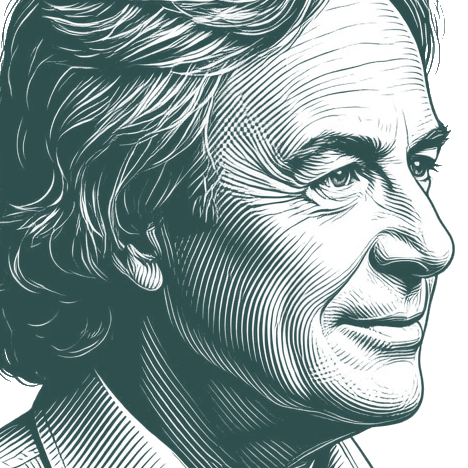
Bio from: Wikiquote (CC BY-SA 4.0) · Portrait adapted from: Wikimedia Commons, Copyright Tamiko Thiel 1984 (CC BY-SA)
From Wikidata (CC0)
"I wanted very much to learn to draw, for a reason that I kept to myself: I wanted to convey an emotion I have about the beauty of the world. It's difficult to describe because it's an emotion. It's analogous to the feeling one has in religion that has to do with a god that controls everything in the whole universe: there's a generality aspect that you feel when you think about how things that appear so different and behave so differently are all run "behind the scenes" by the same organization, the same physical laws. It's an appreciation of the mathematical beauty of nature, of how she works inside; a realization that the phenomena we see result from the complexity of the inner workings between atoms; a feeling of how dramatic and wonderful it is. It's a feeling of awe — of scientific awe — which I felt could be communicated through a drawing to someone who had also had this emotion. It could remind him, for a moment, of this feeling about the glories of the universe."
Enhance Your Quote Experience
Enjoy ad-free browsing, unlimited collections, and advanced search features with Premium.
"Are you looking for the ultimate laws of physics?" No, I'm not. I'm just looking to find out more about the world and if it turns out there is a simple ultimate law which explains everything, so be it; that would be very nice to discover. If it turns out it's like an onion with millions of layers and we're just sick and tired of looking at the layers, then that's the way it is. ... My interest in science is to simply find out more about the world.
We absolutely must leave room for doubt or there is no progress and no learning. There is no learning without having to pose a question. And a question requires doubt. People search for certainty. But there is no certainty. People are terrified — how can you live and not know? It is not odd at all. You only think you know, as a matter of fact. And most of your actions are based on incomplete knowledge and you really don't know what it is all about, or what the purpose of the world is, or know a great deal of other things. It is possible to live and not know.
That is the idea that we all hope you have learned in studying science in school — we never explicitly say what this is, but just hope that you catch on by all the examples of scientific investigation. It is interesting, therefore, to bring it out now and speak of it explicitly. It’s a kind of scientific integrity, a principle of scientific thought that corresponds to a kind of utter honesty — a kind of leaning over backwards.
For example, if you’re doing an experiment, you should report everything that you think might make it invalid — not only what you think is right about it: other causes that could possibly explain your results; and things you thought of that you’ve eliminated by some other experiment, and how they worked — to make sure the other fellow can tell they have been eliminated.
Details that could throw doubt on your interpretation must be given, if you know them. You must do the best you can — if you know anything at all wrong, or possibly wrong — to explain it. If you make a theory, for example, and advertise it, or put it out, then you must also put down all the facts that disagree with it, as well as those that agree with it. There is also a more subtle problem. When you have put a lot of ideas together to make an elaborate theory, you want to make sure, when explaining what it fits, that those things it fits are not just the things that gave you the idea for the theory; but that the finished theory makes something else come out right, in addition.
In summary, the idea is to try to give all of the information to help others to judge the value of your contribution; not just the information that leads to judgment in one particular direction or another.
The first principle is that you must not fool yourself — and you are the easiest person to fool. So you have to be very careful about that. After you’ve not fooled yourself, it’s easy not to fool other scientists...
You just have to be honest in a conventional way after that.
Then the son told me what happened. The last time he was there, Bohr said to his son, “Remember the name of that little fellow in the back over there? He’s the only guy who’s not afraid of me, and will say when I’ve got a crazy idea. So next time when we want to discuss ideas, we’re not going to be able to do it with these guys who say everything is yes, yes, Dr. Bohr. Get that guy and we’ll talk with him first.” I was always dumb in that way. I never knew who I was talking to. I was always worried about the physics. If the idea looked lousy, I said it looked lousy. If it looked good, I said it looked good. Simple proposition. I’ve always lived that way. It’s nice, it’s pleasant — if you can do it. I’m lucky in my life that I can do this.
So we have these wide principles which sweep across all the different laws, and if one takes too seriously its derivations, and feels that this is only valid because this [assumed more fundamental principle] is valid, you cannot understand the interconnections of the different branches of physics. Some day, when physics is complete, then maybe with this kind of argument we'll know all the laws, then we can start with some axioms (and no doubt somebody will figure out a particular way of doing it) and then all the deductions will be made. But while we don't know all the laws, we can use some to make guesses at theorems which extend beyond the proof.
It's a great game to try to look at the past, at an unscientific era, look at something there, and say have we got the same thing now, and where is it? So I would like to amuse myself with this game. First, we take witch doctors. The witch doctor says he knows how to cure. There are spirits inside which are trying to get out. ... Put a snakeskin on and take quinine from the bark of a tree. The quinine works. He doesn't know he's got the wrong theory of what happens. If I'm in the tribe and I'm sick, I go to the witch doctor. He knows more about it than anyone else. But I keep trying to tell him he doesn't know what he's doing and that someday when people investigate the thing freely and get free of all his complicated ideas they'll learn much better ways of doing it. Who are the witch doctors? Psychoanalysts and psychiatrists, of course.
Works in ChatGPT, Claude, or Any AI
Add semantic quote search to your AI assistant via MCP. One command setup.