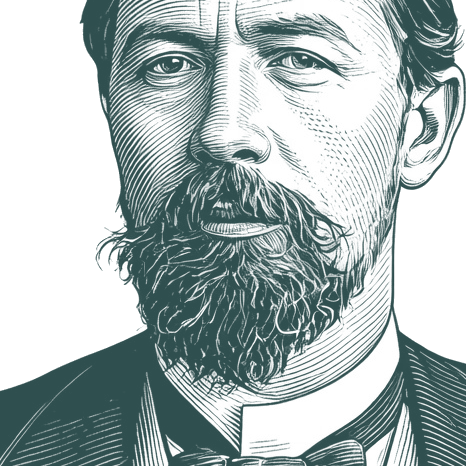
As a rule, however fine and deep a phrase may be, it only affects the indifferent, and cannot fully satisfy those who are happy or unhappy; that is w… - Anton Chekhov
""
As a rule, however fine and deep a phrase may be, it only affects the indifferent, and cannot fully satisfy those who are happy or unhappy; that is why dumbness is most often the highest expression of happiness or unhappiness; lovers understand each other better when they are silent, and a fervent, passionate speech delivered by the grave only touches outsiders, while to the widow and children of the dead man it seems cold and trivial.
Anton Pavlovich Chekhov (Анто́н Па́влович Че́хов) (29 January 1860 – 15 July 1904) (Old Style: 17 January 1860 – 2 July 1904) was a Russian short story writer and playwright.
Just look at this life: the insolence and idleness of the strong, the ignorance and brutishness of the weak, impossible poverty all around us, overcrowding, degeneracy, drunkenness, hypocrisy, lies...Yet in all the houses and streets it's quiet, peaceful; of the fifty thousand people who live in town there is not one who would cry out or become loudly indignant. We see those who go to the market to buy food, eat during the day, sleep during the night, who talk their nonsense, get married, grow old, complacently drag their dead to the cemetery; but we don't see or hear those who suffer, and the horrors of life go on somewhere behind the scenes. Everything is quiet, peaceful, and only mute statistics protest: so many gone mad, so many buckets drunk, so many children dead of malnutrition... And this order is obviously necessary; obviously the happy man feels good only because the unhappy bear their burden silently, and without that silence happiness would be impossible. It's a general hypnosis. At the door of every happy, contented man somebody should stand with a little hammer, constantly tapping, to remind him that unhappy people exist, that however happy he may be, sooner or later life will show him its claws, some calamity will befall him — illness, poverty, loss — and nobody will hear or see, just as he doesn't hear or see others now. But there is nobody with a little hammer, the happy man lives on, and the petty cares of life stir him only slightly, as wind stirs an aspen — and everything is fine.
The State is not God. It has no right to take away that which it cannot give back, if it should so desire.
Limited Time Offer
Premium members can get their quote collection automatically imported into their Quotewise collections.