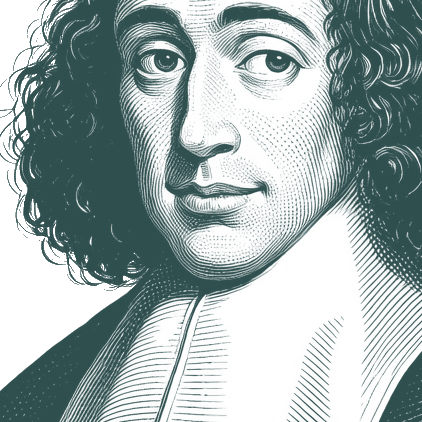
Benedictus de Spinoza (24 November 1632 – 21 February 1677) was a social and metaphysical philosopher known for the elaborate development of his monist philosophy, which has become known as Spinozism. Controversy regarding his ideas led to his excommunication from the Jewish community of his native Amsterdam. He was named Baruch ("blessed" in Hebrew) Spinoza by his synagogue elders and known as Bento de Spinoza or Bento d'Espiñoza, but afterwards used the name Benedictus ("blessed" in Latin) de Spinoza.
Native Name:
בָּרוּךְ שְׂפִּינוֹזָה
•
Benedito de Espinosa
Alternative Names:
Benedict de Spinoza
•
Baruch de Espinosa
•
Barukh Shpinozah
•
Benoît de Spinoza
•
Sbīnūzā
•
Ispīnūzā
•
Barukh Spinoza
•
Bento de Espinosa
•
Baruch d' Espinoza
•
Shpinozah
•
Baruch de Spinoza
•
Spinoza
•
Benoit de Spinoza
•
Benedictus De Spinoza
•
Benedictus Spinoza
•
Baruch Spinoza
•
Baruch Benedictus de Spinoza
That was in 1656, and Spinoza died in 1677, at the early age of forty-four. Glory had not found him out. His short life—a life of unbroken diligence, kindliness, and purity—was passed in seclusion. But in spite of that seclusion, in spite of the shortness of his career, in spite of the hostility of the dispensers of renown in the 18th century,—of Voltaire's disparagement and Bayle's detraction,—in spite of the repellent form which he has given to his principal work, in spite of the exterior semblance of a rigid dogmatism alien to the most essential tendencies of modern philosophy, in spite, finally, of the immense weight of disfavour cast upon him by the long-repeated charge of atheism, Spinoza's name has silently risen in importance, the man and his work have attracted a steadily increasing notice, and bid fair to become soon what they deserve to become,—in the history of modern philosophy the central point of interest.
Spinoza does not believe that worshipful awe is an appropriate attitude to take before God or nature. There is nothing holy or sacred about nature, and it is certainly not the object of a religious experience. Instead, one should strive to understand God or nature, with the kind of adequate or clear and distinct intellectual knowledge that reveals nature's most important truths and shows how everything depends essentially and existentially on higher natural causes. The key to discovering and experiencing God/nature, for Spinoza, is philosophy and science, not religious awe and worshipful submission. The latter give rise only to superstitious behaviour and subservience to ecclesiastic authorities; the former leads to enlightenment, freedom and true blessedness (i.e. peace of mind).
PREMIUM FEATURE
Advanced Search Filters
Filter search results by source, date, and more with our premium search tools.