It was the wild strawberries, beneath dewy leaves on an almost-summer morning, who gave me my sense of the world, my place in it. [...] Even now, aft… - Robin Wall Kimmerer
""
It was the wild strawberries, beneath dewy leaves on an almost-summer morning, who gave me my sense of the world, my place in it. [...] Even now, after more than fifty Strawberry Moons, finding a patch of wild strawberries still touches me with a sensation of surprise, a feeling of unworthiness and gratitude for the generosity and kindness that comes with an unexpected gift all wrapped in red and green. "Really? For me? Oh, you shouldn't have." After fifty years they still raise the question of how to respond to their generosity. Sometimes it feels like a silly question with a very simple answer: eat them.
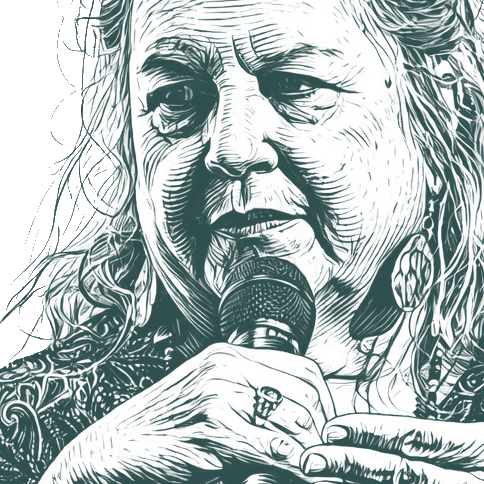
Robin Wall Kimmerer (born September 13, 1953) is an enrolled member of the Citizen Potawatomi Nation who is the Distinguished Teaching Professor of Environmental and Forest Biology; and Director, Center for Native Peoples and the Environment, at the State University of New York College of Environmental Science and Forestry (SUNY-ESF). She is the author of numerous scientific articles, and the books Gathering Moss: A Natural and Cultural History of Mosses (2003), and Braiding Sweetgrass: Indigenous Wisdom, Scientific Knowledge and the Teachings of Plants (2013).
Biography information from
Wikiquote·
Portrait adapted from
Wikimedia Commons, Indiana Humanities (CC BY-SA)
If grief can be a doorway to love, then let us all weep for the world we are breaking apart so we can love it back to wholeness again.
In weaving well-being for land and people, we need to pay attention to the lessons of the three rows. Ecological well-being and the laws of nature are always the first row. Without them, there is no basket of plenty. Only if that first circle is in place can we weave the second. The second reveals material welfare, the subsistence of human needs. Economy built upon ecology. But with only two rows in place, the basket is still in jeopardy of pulling apart. It’s only when the third row comes that the first two can hold together. Here is where ecology, economics, and spirit are woven together. By using materials as if they were a gift, and returning that gift through worthy use, we find balance. I think that third row goes by many names: Respect. Reciprocity. All Our Relations. I think of it as the spirit row. Whatever the name, the three rows represent recognition that our lives depend on one another, human needs being only one row in the basket that must hold us all. In relationship, the separate splints become a whole basket, sturdy and resilient enough to carry us into the future.
Enhance Your Quote Experience
Enjoy ad-free browsing, unlimited collections, and advanced search features with Premium.
Paying attention acknowledges that we have something to learn from intelligences other than our own. Listening, standing witness, creates an openness to the world in which the boundaries between us can dissolve in a raindrop.