American writer (born 1945)
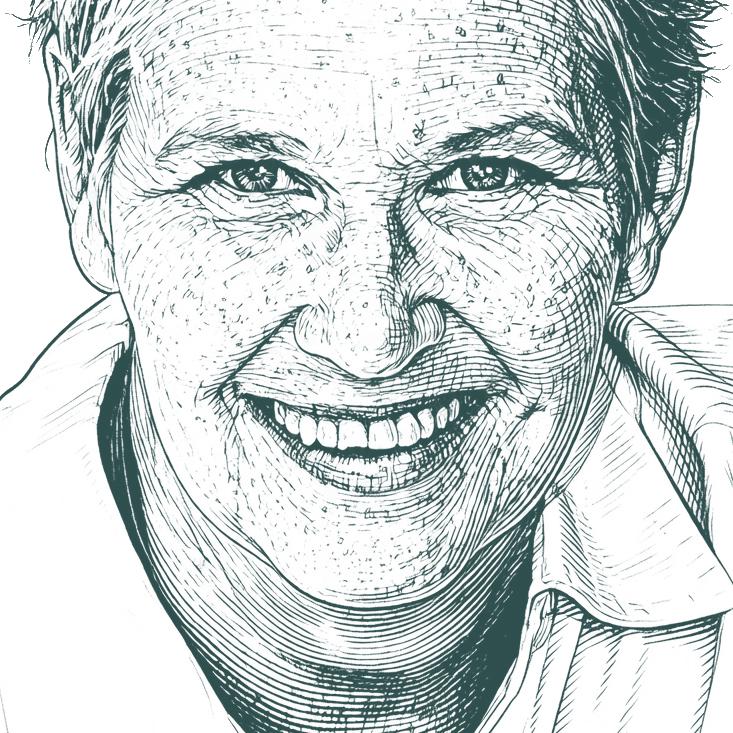
Annie Dillard (born 30 April 1945) is an American author born in Pittsburgh, Pennsylvania. She won the Pulitzer Prize for her non-fiction narrative Pilgrim at Tinker Creek in 1974. She has since published ten other books. Her most recent is the novel The Maytrees (June 2007).
Bio from: Wikiquote (CC BY-SA 4.0) · Portrait adapted from: Wikimedia Commons, Photo by Phyllis Rose (CC BY-SA)
From Wikidata (CC0)
The most appealing daily schedule I know is that of a turn-of-the-century Danish aristocrat. He got up at four and set out on foot to hunt black grouse, wood grouse, woodcock, and snipe. At eleven he met his friends, who had also been out hunting alone all morning. They converged "at one of these babbling brooks," he wrote.
He outlined the rest of his schedule. "Take a quick dip, relax with a schnapps and a sandwich, stretch out, have a smoke, take a nap or just rest, and then sit around and chat until three. Then I hunt some more until sundown, bathe again, put on a white tie and tails to keep up appearances, eat a huge dinner, smoke a cigar and sleep like a log until the sun comes up again to redden the eastern sky. This is living … Could it be more perfect?"
Limited Time Offer
Premium members can get their quote collection automatically imported into their Quotewise collections.
There is no shortage of good days. It is good lives that are hard to come by. A life of good days lived in the senses is not enough. The life of sensation is the life of greed; it requires more and more. The life of the spirit requires less and less; time is ample and its passage sweet. Who would call a day spent reading a good day? But a life spent reading — that is a good life.
In the great meteor shower of August, the Perseid, I wail all day for the shooting stars I miss. They’re out there showering down, committing hari-kiri in a flame of fatal attraction, and hissing perhaps into the ocean. But at dawn what looks like a blue dome clamps down over me like a lid on a pot. The stars and planets could smash and I’d never know. Only a piece of ashen moon occasionally climbs up or down the inside of the dome, and our local star without surcease explodes on our heads. We have really only that one light, one source for all power, and yet we must turn away from it by universal decree. Nobody here on the planet seems aware of that strange, powerful taboo, that we all walk about carefully averting our faces, this way and that, lest our eyes be blasted forever.
The universe that suckled us is a monster that does not care if we live or die — it does not care if it itself grinds to a halt. It is a beast running on chance and death, careening from nowhere to nowhere. It is fixed and blind, a robot programmed to kill. We are free and seeing; we can only try to outwit it at every turn to save our lives.
Chloroplasts bear chlorophyll; they give the green world its color, and they carry out the business of photosynthesis. Around the inside perimeter of each gigantic cell trailed a continuous loop of these bright green dots. They spun . . . they pulsed, pressed, and thronged . . . they shone, they swarmed in ever-shifting files around and around the edge of the cell; they wandered, they charged, they milled, raced . . . they flowed and trooped greenly . . . All the green in the planted world consists of these whole, rounded chloroplasts . . . If you analyze a molecule of chlorophyll itself, what you get is one hundred thirty-six atoms of hydrogen, carbon, oxygen, and nitrogen arranged in an exact and complex relationship around a central ring. At the ring’s center is a single atom of magnesium. Now: If you remove the atom of magnesium and in its place put an atom of iron, you get a molecule of hemoglobin. The iron atom combines with all the other atoms to make red blood, the streaming red dots in the goldfish’s tail.
So the Midwest nourishes us [...] and presents us with the spectacle of a land and a people completed and certain. And so we run to our bedrooms and read in a fever, and love the big hardwood trees outside the windows, and the terrible Midwest summers, and the terrible Midwest winters [...]. And so we leave it sorrowfully, having grown strong and restless by opposing with all our will and mind and muscle its simple, loving, single will for us: that we stay, that we stay and find a place among its familiar possibilities. Mother knew we would go; she encouraged us.
How we spend our days is, of course, how we spend our lives. What we do with this hour, and that one, is what we are doing. A schedule defends from chaos and whim. It is a net for catching days. It is a scaffolding on which a worker can stand and labor with both hands at sections of time. A schedule is a mock-up of reason and order—willed, faked, and so brought into being; it is a peace and a haven set into the wreck of time; it is a lifeboat on which you find yourself, decades later, still living. Each day is the same, so you remember the series afterward as a blurred and powerful pattern.
Works in ChatGPT, Claude, or Any AI
Add semantic quote search to your AI assistant via MCP. One command setup.
It should surprise no one that the life of the writer — such as it is — is colorless to the point of sensory deprivation. Many writers do little else but sit in small rooms recalling the real world. This explains why so many books describe the author's childhood. A writer's childhood may well have been the occasion of his only firsthand experience.