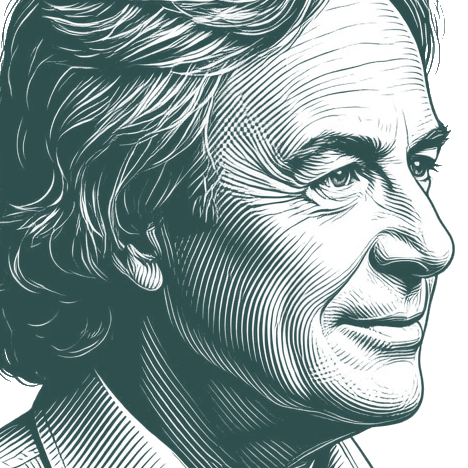
Richard Phillips Feynman (May 11, 1918 – February 15, 1988) was an American theoretical physicist. He is known for the work he did in the path integral formulation of quantum mechanics, the theory of quantum electrodynamics, the physics of the superfluidity of supercooled liquid helium, and in particle physics, for which he proposed the parton model. For his contributions to the development of quantum electrodynamics, Feynman received the Nobel Prize in Physics in 1965 jointly with Julian Schwinger and Shin'ichirō Tomonaga. Feynman developed a widely used pictorial representation scheme for the mathematical expressions describing the behavior of subatomic particles, which later became known as Feynman diagrams. During his lifetime, Feynman became one of the best-known scientists in the world.
Biography information from
Wikiquote·
Portrait adapted from
Wikimedia Commons, Copyright Tamiko Thiel 1984 (CC BY-SA)
Also Known As
Pen Names:
Ofey
Native Name:
Richard Phillips Feynman
Alternative Names:
Feynman
•
Dick Feynman
•
Richard P. Feynman
I believe, therefore, that although it is not the case today, that there may some day come a time, I should hope, when it will fully appreciated that the power of governments should be limited; that governments ought not to be empowered to decide the validity of scientific theories, that this is a ridiculous thing for them to try to do; that they are not to decide the description of history or of economic theory or of philosophy.
If you thought you were trying to find out more about it because you're gonna get an answer to some deep philosophical question...you may be wrong! It may be that you can't get an answer to that particular question by finding out more about the character of nature. But my interest in science is to simply find out about the world.
In general, we look for a new law by the following process: First we guess it; then we compute the consequences of the guess to see what would be implied if this law that we guessed is right; then we compare the result of the computation to nature, with experiment or experience, compare it directly with observation, to see if it works. If it disagrees with experiment, it is wrong. In that simple statement is the key to science. It does not make any difference how beautiful your guess is, it does not make any difference how smart you are, who made the guess, or what his name is — if it disagrees with experiment, it is wrong.