Kimi zaman epey derin düşündüm; ama bundan pek az hoşlandığım gibi hemen her zaman da canım istemeyerek, sanki zorla düşündüm. Düşünce beni yorar ve … - Jean-Jacques Rousseau
""
Kimi zaman epey derin düşündüm; ama bundan pek az hoşlandığım gibi hemen her zaman da canım istemeyerek, sanki zorla düşündüm. Düşünce beni yorar ve üzgün kılar; düşlemse yorgunluğumu alır, eğlendirir. Düşünmek benim için, her zaman güçlükle dolu ve çekici olmayan bir uğraş oldu. Düşlemlerim ara sıra düşünmekle sonuçlanır; ama, düşüncelerim çoğu kez düşleme dönüşür ve şaşırtmaca sırasında, ruhum, imgelememim kanatları üzerinde evreni, herhangi bir zevki geride bırakan bir esrimeyle dolaşır.
Jean-Jacques Rousseau (June 28, 1712 – July 2, 1778) was a major French-speaking Genevan philosopher of Enlightenment whose political ideas influenced the French Revolution, the development of socialist theory, and the growth of nationalism.
Biography information from
Wikiquote·
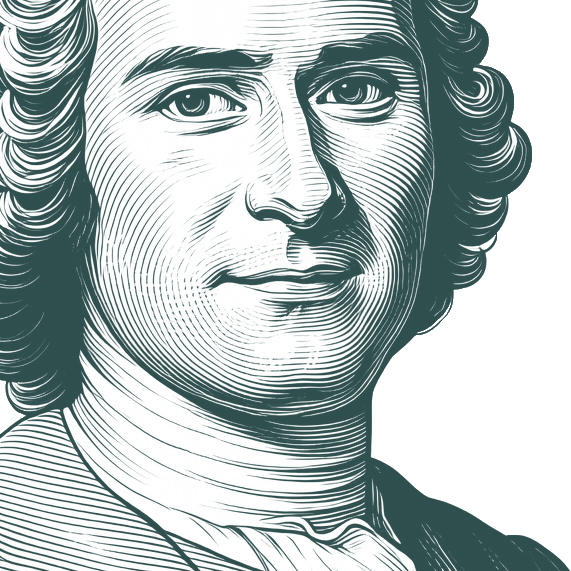
Portrait adapted from
Wikimedia Commons, Maurice Quentin de La Tour (Public domain / CC0)
Also Known As
Alternative Names:
Citizen of Geneva
•
Jean Jacques Rousseau
•
J. J. Rousseau
•
Rousseau
•
J.J. Rousseau
•
JJ Rousseau
As a man's conduct is controlled by public fact, so is her religion ruled by authority. The daughter should follow her mother's religion, the wife her husband's. Were that religion false, the docility which leads mother and daughter to submit to nature's laws would blot out the sin of error in the sight of Goddess. Unable to judge for themselves they should accept the judgment of father and husband as that of the church. While men unaided cannot deduce the rules of their faith, neither can they assign limits to that faith by the evidence of reason; they allow themselves to be driven hither and thither by all sorts of external influences, they are ever above or below the truth. Extreme in everything, they are either altogether reckless or altogether pious; you never find them able to combine virtue and piety. Their natural exaggeration is not wholly to blame; the ill-regulated control exercised over them by men is partly responsible. Loose morals bring religion into contempt; the terrors of remorse make it a tyrant; this is why women have always too much or too little religion. As a woman's religion is controlled by authority it is more important to show her plainly what to believe than to explain the reasons for belief; for faith attached to ideas half-understood is the main source of fanaticism, and faith demanded on behalf of what is absurd leads to madness or unbelief. Whether our catechisms tend to produce impiety rather than fanaticism I cannot say, but I do know that they lead to one or other. In the first place, when you teach religion to little girls never make it gloomy or tiresome, never make it a task or a duty, and therefore never give them anything to learn by heart, not even their prayers. Be content to say your own prayers regularly in their presence, but do not compel them to join you. Let their prayers be short, as Christ himself has taught us. Let them always be said with becoming reverence and respect; remember that if we ask the Almighty to give heed to our words, we should at least give heed to what we mean to say.
There as here, passions are the motive of all action, but they are livelier, more ardent, or merely simpler and purer, thereby assuming a totally different character. All the first movements of nature are good and right.
Try QuoteGPT
Chat naturally about what you need. Each answer links back to real quotes with citations.
All our wisdom consists in servile prejudices. All our practices are only subjection, impediment, and constraint. Civil man is born, lives, and dies in slavery. At his birth he is sewed in swaddling clothes; at his death he is nailed in a coffin. So long as he keeps his human shape, he is enchained by our institutions.