we find among the Jews, as well as other nations, that men did sell themselves; but, it is plain, this was only to drudgery, not to slavery: - John Locke
""
we find among the Jews, as well as other nations, that men did sell themselves; but, it is plain, this was only to drudgery, not to slavery:
John Locke (29 August 1632 – 28 October 1704) was an influential English philosopher and social contract theorist. He developed an alternative to the Hobbesian state of nature and asserted a government could be good only if it received the consent of the governed and protected the natural rights of life, liberty, and estate. If such a consent was not achieved, Locke argued in favour of a right of rebellion, which he referred to as an "appeal to heaven".
Biography information from
Wikiquote·
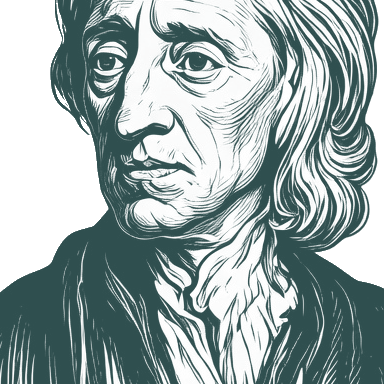
Portrait adapted from
Wikimedia Commons, Godfrey Kneller (Public domain / CC0)
We are not at all to wonder [...] that we having but some few superficial ideas of things, discovered to us only by the senses from without, or by the mind, reflecting on what it experiments in itself within, have no knowledge beyond that, much less of the internal constitution, and true nature of things, being destitute of faculties to attain it.
For where is the man that has incontestable evidence of the truth of all that he holds, or of the falsehood of all he condemns; or can say that he has examined to the bottom all his own, or other men's opinions? The necessity of believing without knowledge, nay often upon very slight grounds, in this fleeting state of action and blindness we are in, should make us more busy and careful to inform ourselves than constrain others. At least, those who have not thoroughly examined to the bottom all their own tenets, must confess they are unfit to prescribe to others; and are unreasonable in imposing that as truth on other men's belief, which they themselves have not searched into, nor weighed the arguments of probability, on which they should receive or reject it. Those who have fairly and truly examined, and are thereby got past doubt in all the doctrines they profess and govern themselves by, would have a juster pretence to require others to follow them: but these are so few in number, and find so little reason to be magisterial in their opinions, that nothing insolent and imperious is to be expected from them: and there is reason to think, that, if men were better instructed themselves, they would be less imposing on others.
Limited Time Offer
Premium members can get their quote collection automatically imported into their Quotewise collections.