I returned to civilization shortly after that and went to Cornell to teach, and my first impression was a very strange one. I can't understand it any… - Richard Feynman
""
I returned to civilization shortly after that and went to Cornell to teach, and my first impression was a very strange one. I can't understand it any more, but I felt very strongly then. I sat in a restaurant in New York, for example, and I looked out at the buildings and I began to think, you know, about how much the radius of the Hiroshima bomb damage was and so forth... How far from here was 34th street?... All those buildings, all smashed — and so on. And I would go along and I would see people building a bridge, or they'd be making a new road, and I thought, they're crazy, they just don't understand, they don't understand. Why are they making new things? It's so useless.
But, fortunately, it's been useless for almost forty years now, hasn't it? So I've been wrong about it being useless making bridges and I'm glad those other people had the sense to go ahead.
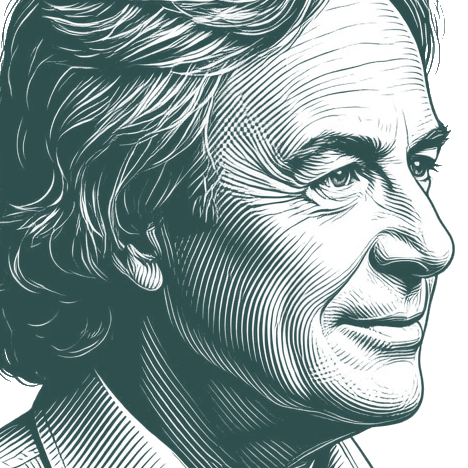
Richard Phillips Feynman (May 11, 1918 – February 15, 1988) was an American theoretical physicist. He is known for the work he did in the path integral formulation of quantum mechanics, the theory of quantum electrodynamics, the physics of the superfluidity of supercooled liquid helium, and in particle physics, for which he proposed the parton model. For his contributions to the development of quantum electrodynamics, Feynman received the Nobel Prize in Physics in 1965 jointly with Julian Schwinger and Shin'ichirō Tomonaga. Feynman developed a widely used pictorial representation scheme for the mathematical expressions describing the behavior of subatomic particles, which later became known as Feynman diagrams. During his lifetime, Feynman became one of the best-known scientists in the world.
Biography information from
Wikiquote·
Portrait adapted from
Wikimedia Commons, Copyright Tamiko Thiel 1984 (CC BY-SA)
Also Known As
Pen Names:
Ofey
Native Name:
Richard Phillips Feynman
Alternative Names:
Feynman
•
Dick Feynman
•
Richard P. Feynman
I am going to tell you what nature behaves like. If you will simply admit that maybe she does behave like this, you will find her a delightful, entrancing thing. Do not keep saying to yourself, if you can possibly avoid it, ‘But how can it be like that?’ because you will get ‘down the drain’, into a blind alley from which nobody has yet escaped. Nobody knows how it can be like that.
Quantum mechanics describes nature as absurd from the point of view of common sense. And yet it fully agrees with experiment. So I hope you can accept nature as She is - absurd.
Works in ChatGPT, Claude, or Any AI
Add semantic quote search to your AI assistant via MCP. One command setup.