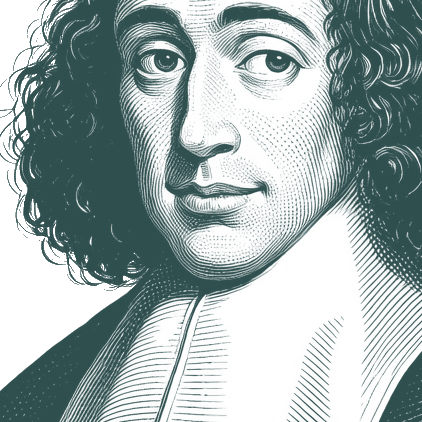
Spinoza used the terminology of Descartes, and also published an account of his system. For we find the first of Spinoza's works entitled “An Exposit… - Benedictus de Spinoza
""
Spinoza used the terminology of Descartes, and also published an account of his system. For we find the first of Spinoza's works entitled “An Exposition according to the geometrical method of the principles of the Cartesian philosophy.” Some time after this he wrote his Tractatus theologico-politicus, and by it gained considerable reputation. Great as was the hatred which Spinoza roused amongst his Rabbis, it was more than equalled by the odium which he brought upon himself amongst Christian, and especially amongst Protestant theologians — chiefly through the medium of this essay. It contains his views on inspiration, a critical treatment of the books of Moses and the like chiefly from the point of view that the laws therein contained are limited in their application to the Jews. Later Christian theologians have written critically on this subject, usually making it their object to show that these books were compiled at a later time, and that they date in part from a period subsequent to the Babylonian captivity; this has become a crucial point with Protestant theologians, and one by which the modern school distinguishes itself from the older, greatly pluming itself thereon. All this, however, is already to be found in the above-mentioned work of Spinoza. But Spinoza drew the greatest odium upon himself by his philosophy proper, which we must now consider as it is given to us in his Ethics. While Descartes published no writings on this subject, the Ethics of Spinoza is undoubtedly his greatest work; it was published after his death by Ludwig Mayer, a physician, who had been Spinoza's most intimate friend. It consists of five parts; the first deals with God (De Deo). General metaphysical ideas are contained in it, which include the knowledge of God and nature. The second part deals with the nature and origin of mind (De natura et origine mentis). We see thus that Spinoza does not treat of the subject of natural philosophy, extension and motion at all, for he passes immediately from God to the philosophy of mind, to the ethical point of view; and what refers to knowledge, intelligent mind, is brought forward in the first part, under the head of the principles of human knowledge. The third book of the Ethics deals with the origin and nature of the passions (De oriqine et natura affectuum); the fourth with the powers of the same, or human slavery (De servitute humana seu de affectuum viribus); the fifth, lastly, with the power of the understanding, with thought, or with human liberty (De potentia intellectus seu de libertate humana). Kirchenrath Professor Paulus published Spinoza's works in Jena; I had a share in the bringing out of this edition, having been entrusted with the collation of French translations.
Benedictus de Spinoza (24 November 1632 – 21 February 1677) was a social and metaphysical philosopher known for the elaborate development of his monist philosophy, which has become known as Spinozism. Controversy regarding his ideas led to his excommunication from the Jewish community of his native Amsterdam. He was named Baruch ("blessed" in Hebrew) Spinoza by his synagogue elders and known as Bento de Spinoza or Bento d'Espiñoza, but afterwards used the name Benedictus ("blessed" in Latin) de Spinoza.
Native Name:
בָּרוּךְ שְׂפִּינוֹזָה
•
Benedito de Espinosa
Alternative Names:
Benedict de Spinoza
•
Baruch de Espinosa
•
Barukh Shpinozah
•
Benoît de Spinoza
•
Sbīnūzā
•
Ispīnūzā
•
Barukh Spinoza
•
Bento de Espinosa
•
Baruch d' Espinoza
•
Shpinozah
•
Baruch de Spinoza
•
Spinoza
•
Benoit de Spinoza
•
Benedictus De Spinoza
•
Benedictus Spinoza
•
Baruch Spinoza
•
Baruch Benedictus de Spinoza
The question of Spinozism is indeed central and indispensable to any proper understanding of Early Enlightenment European thought. Its prominence in European intellectual debates of the late seventeenth and early eighteenth century is generally far greater than anyone would suppose from the existing secondary literature; one of the chief aims of this present study is to demonstrate that there has been a persistent and unfortunate tendency in modern historiography to misconstrue and underestimate its significance. Admittedly, the term 'Spinosisme' as used in the French Enlightenment, or Spinozisterey, as it was called in Germany, was frequently employed, as in the campaign against Montesquieu, rather broadly to denote virtually the whole of the Radical Enlightenment, that is, all deistic, Naturalistic, and atheistic systems that exclude divine Providence, Revelation, and miracles, including reward and punishment in the hereafter, rather than strict adherence to Spinoza's system as such. Yet this does not mean that it was a vague or meaningless usage. On the contrary, the extremely frequent and extensive use of the terms Spinozism and Spinosistes in Early Enlightenment discourse, not least in Bayle, who devoted the longest single article in his Dictionnaire historique et critique to the subject of Spinoza and Spinosisme, is precisely intended to connect—and with considerable justification, as we shall see—Spinoza's philosophy with a wide-ranging network of other radical thought.
The mind of God is all the mentality that is scattered over space and time, the diffused consciousness that animates the world.
comme les mots sont une partie de l'imagination, c'est-à-dire que, selon qu'une certaine disposition du corps fait qu'ils se sont arrangés vaguement dans la mémoire, nous nous formons beaucoup d'idées chimériques, il ne faut pas douter que les mots, ainsi que l'imagination, puissent être cause de beaucoup de grossières erreurs, si nous ne nous tenons fort en garde contre eux. Joignez à cela qu'ils sont constitués arbitrairement et accommodés au goût du vulgaire, si bien que ce ne sont que des signes des choses telles qu'elles sont dans l'imagination, et non pas telles qu'elles sont dans l'entendement ; vérité évidente si l'on considère que la plupart des choses qui sont seulement dans l'entendement ont reçu des noms négatifs, comme immatériel, infini, etc., et beaucoup d'autres idées qui, quoique réellement affirmatives, sont exprimées sous une forme négative, telle qu'incréé, indépendant, infini, immortel, et cela parce que nous imaginons beaucoup plus facilement les contraires de ces idées, et que ces contraires, se présentant les premiers aux premiers hommes, ont usurpé les noms affirmatifs. Il y a beaucoup de choses que nous affirmons et que nous nions parce que telle est la nature des mots, et non pas la nature des choses. Or, quand on ignore la nature des choses, rien de plus facile que de prendre le faux pour le vrai.