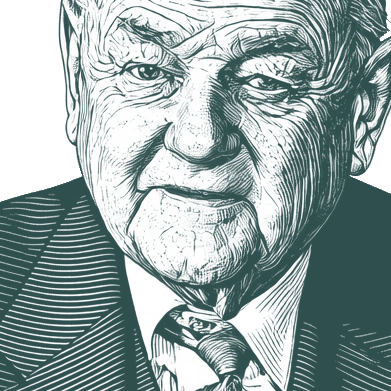
The whole position is a crystal clear example of the proposition that commitments and power must be balanced. Failure to balance them leads to bankru… - Quintin Hogg, Baron Hailsham of St Marylebone
""
The whole position is a crystal clear example of the proposition that commitments and power must be balanced. Failure to balance them leads to bankruptcy, moral, political, and diplomatic. Neither Britain nor America was capable of paying the debt of honour. Why? Not because we did not support the League. Not because we did not believe in collective security. Not because we loved the Japanese. The reason is much simpler. Years of pacifism, disarmament, and false economy had deprived us of the power to do so.
About
Quintin Hogg, Baron Hailsham of St Marylebone
The Right Honourable Quintin McGarel Hogg, Baron Hailsham of St Marylebone KG CH PC (9 October 1907 – 12 October 2001), formerly 2nd Viscount Hailsham (1950–1963), was a British Conservative politician.
Additional quotes by Quintin Hogg, Baron Hailsham of St Marylebone
The fundamental principle of all foreign policy is that enunciated by Mr. Walter Lippmann, when he writes that you must balance commitments with power. To fail to do this is not brave, moral, "realistic", "idealistic", "progressive", or "reactionary". It is merely silly. To incur commitments without building up power to discharge them and to call this practice collective security is at the worst political chicanery and at the best self-deception, and leads inevitably to bankruptcy, military, political, and moral. This was consistently the policy of the Left in the years 1919–39.
Nothing has shown so clearly the evils of elective dictatorship as the past few weeks, which had culminated in the Lib–Lab pact.
Enhance Your Quote Experience
Enjoy ad-free browsing, unlimited collections, and advanced search features with Premium.
It is simply not true, as the authors of Guilty Men and Cassius assert, that the Labour Party, as a Party, was not pacifist, that its pacifism was limited to a few groups or individuals, that its pacifism ceased on the appearance of Hitler or did not continue long after his rise to power. From the first the Labour Party was riddled with pacifism. Its theory was pacifist. Its leaders were pacifist. Its members were pacifist, and its declared policy was pacifist. Disarmament it preached as party policy and because Conservatives were known to preach patriotism and strong armaments. As early as 1922 pacifism became the official doctrine of the Labour movement. At the Edinburgh Conference in that year a motion was carried that Socialist Parties everywhere should "oppose any war entered into by any government, whatever the ostensible object of the war". In 1923 the Party Conference at London pronounced in favour of "immediate Universal Disarmament by mutual agreement". There are even now Labour Members of Parliament who would fail to understand that such a policy must always put a premium on aggression, since it would give a would-be aggressor an automatic start. In 1926 the Margate Conference approved a policy of treason by general strike, calling on the workers to "meet any threat of war so called defensive or offensive, by organizing a general resistance, including the refusal to bear arms, to produce armaments, or to render any material assistance". At the Birmingham Conference, 1928, the Party's policy: "Labour and the Nation" was adopted. This included the renunciation of War, and Disarmament.